


Regenerative wool
Well known for its unique performance properties, wool may be a source of broader positive impacts as growers around the world begin to implement regenerative agricultural practices. The quality of a sheep’s wool fibres depends on the animal’s health and wellbeing. These form an integral part of the programmes that are rolling out.
The contribution of sheep to mitigating global warming is not the first thing that comes to mind when assessing the performance characteristics and sustainable nature of wool. The fibre has edged out polyester in a number of market segments for its ability to absorb moisture without becoming clammy, to thermoregulate the body in varying temperature conditions and to do so without generating unpleasant odours. For this reason, clothes made from wool tend to be washed less often and worn longer, further reducing their environmental footprint. To these well-established properties, the natural fibre could contribute a new series of benefits as farmers shift to regenerative agriculture.
HD Wool is the first company to offer regenerative agriculture-certified wool in its range of thermal insulations for outerwear. The UK-based wool specialist has partnered with the Savory Institute, an organisation founded in 2009 by Allan Savory to promote the practice of regenerative farming, believing it to be capable of “reversing climate change before it is too late”. HD Wool has adopted its certification system, Land to Market, which monitors soil health, biodiversity and ecosystem function based on a methodology known as Ecological Outcome Verification (EOV).
Working closely with wool growers in the UK, HD wool had previously joined forces with Perthshire-based wool buyer Brannach Olann to establish the WoolKeepers programme. Launched in 2019, this “farm gate to shop front” supply chain system provides traceability and transparency to brands and guarantees growers price stability. “It is not a certification scheme per se, but an assurance platform and promotion mechanism for small, isolated farmers, some of whom apply regenerative agricultural practices and whose stewardship is focused on the wellbeing of their sheep,” says HD Wool CEO, Jo Dawson.
A fundamental aspect of the programme is to ensure that farmers receive a fair price for their wool. “Helping farmers to turn a profit encourages them to grow better wool,” he says. For brands, Woolkeepers offers an opportunity to market a positive story, backed by imagery and videos. A QR code on the finished product will trace it back to the farms from which the wool was sourced. Since its inception, some 600 farmers have joined the programme, producing 520 tonnes of wool in 2020. Mr Dawson believes there is potential to expand Woolkeepers beyond the UK to other wool-growing countries.
The New Zealand Merino Company (NZM) has just released its own regenerative agriculture platform under the ZQRX label. The Christchurch-based organisation says 167 wool growers have joined the programme, representing some 2.4 million acres (more than one million hectares) in New Zealand. “ZQRX is the start of a global movement toward brands, businesses and growers working together to address critical global issues such as climate change and biodiversity loss. We dream of a day when all wool is farmed with regenerative practices,” said NZM CEO, John Brakenridge, in a statement. Icebreaker, Smartwool and Allbirds are the first brands to support the programme.
In Australia, the biggest producer of wool in the world, a similar move is under way with SustainaWOOL, an integrity scheme that covers animal welfare and land management. This programme was initially set up in 2015 by Italian wool specialists Successori Reda and Vitale Barberis Canonico to secure high-quality wool and best practices. In 2019, ownership was transferred to the Australian Wool Exchange (AWEX). The programme now has over 1,000 members, representing 10% of Australia’s wool clip. SustainaWOOL-certified wool is traced from farm to preparer; each bale must be labelled, correctly classified, and traceable using electronic bale labels.
SustainaWOOL seeks to improve practices at all levels, from grazing to shearing. “Our farmers are well aware that good animal stewardship gives better results. Twenty years ago, their main focus was productivity, they now seek to improve quality and conditions, and are more inclined to be audited. This is part of a broader transition from commodity to demand-driven social responsibility. Ethical and social issues are front and centre,” says SustainaWOOL programme manager, Dr Paul Swan.
The Responsible Wool Standard (RWS), a certification system managed by the Textile Exchange, has included new biodiversity requirements and social welfare in its latest version, introduced in March 2020. The number of certified farms has grown from 95 in 2017 to 745 in 2019, the organisation states in a market report for 2020. New South Wales farm Gostwyck in is one of the new members of this club. The property had no trouble meeting the criteria to achieve RWS certification and is often cited as an example of best practice in the country.
“You are what you eat, be you a sheep or a human. If the grass is of good quality, you will have happy and healthy sheep, and to grow quality grass, you need to look after the biology of the soil,” Gostwyck owner, Philip Attard, tells WSA. This, he says, is the basis of regenerative agricultural and grazing. “We haven’t implemented these measures to qualify for a specific certification system. We do it because it is fundamental to quality wool and to sustain our business. We started managing soil and grass 20 years ago, before regenerative agricultural was trendy.”
As can be expected, his approach to animal welfare follows the same high standards. “We have been taking great care of our animals from the very beginning,” he says. The grower has not mulesed a lamb since 2005. Other operations, such as tail-docking and castration, are applied with an anaesthetic and pain-reducing tools. “Our staff is trained to minimise any source of stress,” he says.
Breeding out flystrike
In response to the evolution of consumer attitudes towards animal welfare, many sports apparel brands have committed to sourcing only non-mulesed wool. On farms in Australia, and to a lesser extent in New Zealand, this procedure of shearing the breech area of lambs to reduce the risk (and pain) of flystrike is slowly being phased out. In 2004, the Australian wool industry pledged to eliminate it by the end of 2010, but dropped the plan in 2009. The New Zealand industry began addressing the issue in 2007 and an official ban came into effect in 2018.
The Australian industry’s commitment to phase out mulesing by 2010 was, in retrospect “hopelessly optimistic,” says Dr Swan. “The industry has invested heavily in alternative technologies, without much success,” he concedes. One of the more promising solutions being investigated is to breed out flystrike through genetics so as to rear ‘plain-bodied’ Merino sheep. These will have no, or only slight skin folds in the body, removing the need for mulesing. “But the normal generation interval for Merino sheep is at least two years,” Dr Swan points out, suggesting that it will take time to fully address the issue across many flocks.
Australian growers have switched to non-surgical solutions to reduce bleeding and discomfort, one of these being the freezing of the breech area. ”I am not against these methods, as it could stop farmers from mulesing, but any treatment applied to the animals should be clearly indicated,” points out Mr Attard.
Since 2001, Australian wool growers have invested AU$74.5 million (around $58 million) into research and development that focuses on the health and welfare of their sheep, says Dr Jane Littlejohn, general manager for research at Australian Wool Innovation (AWI). “The development and wide industry adoption of pain relief for mulesing has increased from 0% in 2006, when the first analgesia product became available, to more than 86% in 2020,” she says, whilst 17,000 people have been trained in best-practice shearing and wool handling since 2015.
“At present, roughly one in every six bales sold in Australia is non-mulesed. The proportion is rising as price premiums for this type of wool increase,” says Dr Swan, who believes the rate of change will accelerate in the coming years. He adds that the sustainaWOOL framework was recently revised to better address the issue of pain relief for tail-docking and castration. “We have recommended to all our growers and supply chain partners that irrespective of whether mulesing occurs or not, pain relief should be provided for tail-docking and castration, and will look to make it a requirement in the coming 12 months.”
Regenerative sheep
Farming methods are also evolving to improve soil health, as Dr Littlejohn at AWI points out: “Australian wool growers have been leaders in the development and implementation of regenerative farming to support the environment and ecosystem health of their properties. Many Australian wool growers work with national initiatives such as Greening Australia and Landcare to restore ecosystem health and actively regenerate farmland. The industry is also currently developing a Sheep Sustainability Framework that will outline the initiatives and metrics for wool growers and the wider industry to measure the impact their stewardship practices have on the environment."
SustainaWOOL will also be revised to better address regenerative agricultural methods. “The challenge for us is to validate positive environmental change over time on more than 1,000 individual properties and address difficult-to-assess indicators such as biodiversity. The next iteration of our grower manual, due in June, will contain significant developments in this area,” says Dr Swan.
Back in the UK, Jo Dawson believes that sheep and nature make a perfect match. “They contribute in many ways to carbon capture and healthy soil. They are powerful fertilisers, and can sequester more carbon than they emit. If well managed, specifically with regards to flock movement, sheep can enhance the water cycle as their cloven hooves break up soil and push dung underground to fertilise soil, thus preventing topsoil loss during heavy rainfall and promoting the growth of roots. If roots are healthier, the grass will be more resilient, and the roots will provide more nutrients and minerals to the animals,” he says. This helps avoid the use of pesticides, reduces cost, and improves biodiversity, “it is all a part of a healthy ecosystem and it is good for business”. He insists that well-managed flocks have the potential to help reverse climate warming.
Innovation is up
In addition to introducing the first Regenerative Agriculture certified wool, HD Wool has also expanded its range of products with a lighter-weight insulation (75 gsm) that is said to be softer and more suited to all-season clothing.
Novel non-woven products are in development, Matthias Boehme, a wool specialist and consultant, tells WSA. He is working on a fine open-structured non-woven to make an ultra light insulation that could weigh less than 45 gsm. “It offers the same performance as an insulation three times heavier, and its non-woven structure makes it less costly and faster to manufacture,” he says.
Mr Boehme has helped Lavalan, a division of German wool specialist Baur Vliestoffe, develop local wool supply chains in Europe, and has recently set his eyes on Icelandic wool. “Icelandic sheep have adapted to the island’s hostile environment by developing a coarse cover hair and very fine hair close to the body,” he says. He is working with Icelandic wool trader Istex to develop a novel faux fur made in natural wool. “It is manufactured on vintage machines that are still in operation in Italy. They bind wool slivers on to a cotton substrate,” he says. The result is a novel sheepskin-like material that can be used in clothing and home textiles.
Istex is a vertical organisation that processes 99% of all Icelandic wool – farmers own 80% of the company. Its spinning facility produces knitting yarns to make the famed local sweaters. “The sheep that were brought here a thousand years ago by the Vikings are unique as they have never been crossed with other breeds,” says Eugène Pilard, Istex process manager. The sheep are allowed to roam freely in the summer months and their wool (and meat) can be considered organic, he says, as almost no chemicals are applied either on animals or land. “Icelandic people tend to let nature do her thing; the climate is so rough here, that there is no other way to do things,” he points out.
Seamless knitting
At The Woolmark Company, recent developments include seamless and whole garment knitting technologies that reduce textile waste and increase wearer comfort. For performance applications, an ultrasonic bonding tape is now available. “It creates strong, impermeable seams for complete wind and rain resistant wool-containing garments,” says Julie Davies, general manager for processing innovation for The Woolmark Company. She also mentions the Optim fibre-stretching technology that creates a wind- and water-resistant 100% wool fabric with no chemical finishes.
Icebreaker, now a VF brand, has been instrumental in promoting wool for performance clothing and it has also committed to long-term contracts with wool growers in New Zealand since 2017. In addition to pledging to go plastic-free by 2023 it is also supporting regenerative practices in farming and is part of NZM’s new ZQRX platform. “Regenerative agriculture is good for biodiversity and it can have a massive impact on carbon capture,” said Julian Lings, VF’s sustainability manager at a talk organised by ISPO. In its goal to remove all plastics and synthetics, the brand has increased the proportion of natural fibres in its collections from 84% in 2018 to 87% in 2019, of which 83% is merino wool, he said.
In 2017, The North Face, another VF brand, partnered with Fibershed to make beanies from regenerative wool sourced from the California-based organisation that develops regional and regenerative fibre systems with independent farmers. Despite its high price tag, $60 for a beanie, it sold very well. “It was a tremendous success, and we received very positive consumer reaction. This was a real unlock for the brand,” said Mr Lings at a webinar organised by C.L.A.S.S. on regenerative agriculture.
Timberland, another VF-owned brand, has committed to shift all of the natural materials it uses, namely leather, cotton, rubber and sugar cane, to suppliers applying regenerative farming by 2030. It has partnered with the Savory Institute to meet these goals.
Of all the natural fibres, wool is the one that has the best performance profile for activewear applications. If, at farm level, regenerative agriculture is applied to sheep grazing, its contribution to sustainability could take on a whole new dimension. For brands that support this shift, it is an opportunity to promote materials that are not only more sustainable but also have a positive impact on the health of the planet.
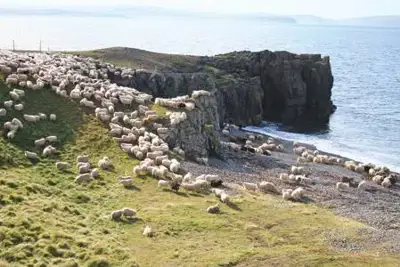
Icelandic sheep have developed a specific type of wool that protects them from the island’s rigorous climate. Istex is a cooperative organisation that processes their fleece and seeks new markets for the wool.
CREDIT: Istex


