


Sustainability – Plans on ice
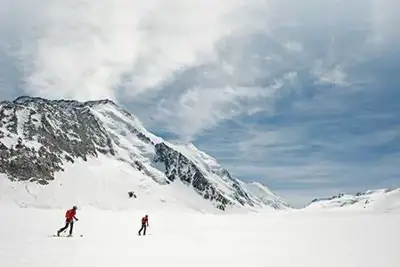
Swiss outdoor brand Mammut is concentrating all of its work on sustainability under a new umbrella term, Together For Glaciers. It says that melting glaciers serve as a reminder that, if we are to stop climate change from causing irrevocable damage to our way of life, time is running out.
Switzerland-based outdoor brand Mammut has announced a plan to present all of its sustainability and corporate responsibility activity under the single, thematic umbrella of ‘Together For Glaciers’. Speaking at ISPO Munich Online 2021 in February, the brand’s corporate responsibility manager, Alice Martin, said Mammut had taken the decision to do this after calculating its carbon footprint and seeing from its analysis the need to set “even clearer priorities”.
Ms Martin talks about having been fascinated by glaciers herself since childhood, describing them as majestic places where snow stayed all year round. They, and the mountains that surround them, remain an important source of inspiration for her. “They form a landscape in which we grow beyond ourselves,” she says. The Aletsch glacier in the Swiss canton of Valais, the largest glacier in the Alps, is a good example.
Time running out
She has crossed it several times on the way to climbing mountains such as the Aletschhorn on the western side. She may have imagined that this glacier and others would always remain as they were when she visited, but scientific modelling predicts that the Aletsch will have melted completely by the end of this century if climate change continues at the rate we have seen in recent years.
Even taking what she calls “severe measures” at a global level and achieving the goals of the Paris Agreement (to limit global temperature increases to less than 1.5°C above pre-industrial levels), most of the glacier will be lost. “As an outdoor brand, and as individuals who love the outdoors, climate change hits us in our innermost being,” she says. “The thought of experiencing that valley without any ice makes me sad, but it also motivates me."
For Alice Martin, glaciers are a symbol of the challenge that companies and consumers face, a visible reminder that time is running out and that reducing CO2 emissions is urgent. She also points out that facing these challenges is “a team sport”; none of us can solve them alone.
Guiding principles
Head of corporate responsibility for the brand, Adrian Huber, explains that Mammut began focusing closely on sustainability in 2002. The basic principles it set out for itself were that it wanted to work with best available technology, to the highest industry standards and with the best partners it could find. It also decided to take a systemic approach to make sure initiatives it put in place would make an impact across the whole of the company. It also realised there was a need to set key performance indicators and targets, to measure what it was doing and to report the results of its efforts transparently.
In 2008, Mammut became the first outdoor brand to join the Fair Wear Foundation, the independent non-profit organisation that aims to improve working conditions in the clothing industry. One year later, it began a switch from conventional cotton to organic. On this, Mr Huber says the benefits of organic cotton are clear: it requires no pesticides and, therefore, if brands choose to use it and farmers grow it in response to that demand, it means fewer hazardous chemicals in the supply chain. Another milestone came in 2013 when Mammut was able to declare that the organic cotton T-shirts it was offering customers were now climate-neutral. One million T-shirts later, this commitment is still in place today.
Natural hat-trick
Around the same time, the company became a member of bluesign to make sure the chemicals in use in its supply chain and in its products are non-hazardous. It also embarked on an initiative to use recycled polyester instead of virgin. It signed up to the Responsible Down Standard in 2015, referring to it as “a breakthrough and an important step toward ethical and completely transparent down supply chains”. It followed this a year later by committing to the Responsible Wool Standard.
It completed a hat-trick of measures to show it procures animal-derived fibres carefully by sourcing more than 80% of the leather for its footwear from German tanner Josef Heinen, using its Terracare leather, which produces lower carbon emissions, less waste and uses 40% less water than the industry standard. “Heinen is a fourth-generation family company that is entirely transparent and has adopted the highest social and environmental practices,” Mr Huber says.
For the sake of comparison
To help it keep to the commitment to measure its impact and to keep track of progress, Mammut is a member of the Sustainable Apparel Coalition (SAC). It is fair to say that confidence in the Higg Materials Sustainability Index (MSI), which the SAC launched in 2012 to help companies assess the sustainability of materials for use in footwear and garments, has been higher than it is at the moment. It has faced criticism for its perceived tendency to favour fossil-fuel-based fibres over natural ones and for a lack of transparency over the methodology it uses to calculate environmental impact. However, Adrian Huber makes a valid point when he says: “The Higg provides a set of tools to measure performance throughout the value chain. All members, and there are more than 200, use the same tools, the same methodology. This allows us to compare ourselves to others, to benchmark."
On signing up to the United Nations ‘Fashion Industry Charter for Climate Action’ in 2018, Mammut took what the head of corporate responsibility refers to as 16 “sub-commitments”, all with a view to aligning itself with the Paris Agreement. One of the outcomes of this is that it has now committed to reducing its greenhouse gas emissions by at least 30% in the next ten years and to become climate-neutral by 2050. It is using the figures it captured for that year, 2018, as a baseline.
Scope for improvement
It measured its total emissions for the year at 58,000 tonnes of CO2-equivalent. Of these, Mammut found that 3% of the total were scope-one emissions, which is to say direct emissions from company-owned and -controlled resources. For scope-two, reflecting its indirect emissions from the energy it consumed that year, the figure was 2% of the total. This means that 95% of the 58,000 tonnes of CO2-equivalent that Mammut took responsibility for in 2018 were scope-three, indirect emissions from upstream and downstream supply-chain partners.
It was no surprise to Adrian Huber that activities Mammut does not own contributed such a large proportion or that the biggest contributor within scope three was materials. A roadmap it has drawn up to meet the target of a 30% reduction within ten years keeps in place its existing commitments to organic cotton, recycled polyester and others. The roadmap also includes new ideas, some of which the company “had to dig deep” to come up with, Mr Huber says. Renting rather than buying products and repairing them rather than throwing them away when damage occurs are two examples of this. Another is a project called Close The Loop, in which Mammut has sourced discarded climbing ropes and used the fibres to produce a new range of functional baselayer garments. This idea, which represents Mammut’s entry into the circular economy, won the ISPO Award for outdoor apparel in 2021.
The company wants the whole world to be “moved by the mountains”, Adrian Huber continues and he explains that it is prepared to enter the realm of politics to achieve this. It is supporting the ‘Glacier Initiative’ in its home country. This is an attempt to anchor the Paris Agreement into Switzerland’s constitution. Citizens will vote on this in a referendum next year.
One step at a time
Before ten years are up Mammut hopes to see clear signs that it is on the way to meeting its target of a 30% reduction and its longer-term aim of becoming climate-neutral. Alice Martin explains that, by 2025, it wants 95% of all the fabrics it uses to be bluesign-approved and 95% of the synthetic fibres it uses to be recycled. By the same date, it wants 100% of the cotton it consumes to be organic.
She gives extra insight into the challenges involved in the switch to recycled synthetic fibres. The polyester in Mammut’s current collections is 38% recycled. Its target for next year is 40%. This will leave plenty to do to lift this proportion to 95% three years later. Work is already under way to achieve this and it is clear already that low-hanging fruit is sparse.
In the summer of 2020, the company decided to look into the possibility of making a new version of its Lenni long-sleeved hiking shirt using recycled fibres. Its current material mix is 68% virgin polyester and 32% virgin polyamide. Initial attempts have had to undergo substantial testing by third parties to make sure the new idea will work in terms of colour, tear-strength, pilling, snagging and other parameters. This takes time. Armed with the results of these tests, the Swiss brand then had to go back and forth with its partner garment manufacturer before satisfying itself that it could put a process in place to bring the new, recycled version of the Lenni to market. It will go ahead and do this now, but it will be the summer of 2022 before consumers can buy the new product, two years after work started. It’s a trek, but that’s what glaciers invite us to undertake.
Rope hope
There are a number of aspects of Mammut’s Close The Loop initiative that make it an ideal entry for the brand into a brave new world of the circular economy. It is not just that it has now found a way to use discarded climbing ropes to make functional baselayer garments, thereby boosting its use of recycled fibres and moving further along a path towards cutting its carbon emissions by 30% within ten years. The story is even more circular than that.
Mammut started out in 1862 as a manufacturer of ropes for use in the mountains. Ropes were its route into the outdoor business, before there was an outdoor business, giving extra meaning to Close The Loop, one of the winners at the ISPO Awards in 2021.
The company still makes ropes for climbers. Safety is always a top priority in the mountains and competitive climbing professionals, mountain guides and other frequent users can easily need new ropes five or six times per year, with few options over what to do with the old ones. Repeat sales are attractive for any company, but Mammut has carried out in-depth analysis of its environmental impact and when it calculated that ropes were contributing 14% of its total greenhouse gas emissions, it stepped up its search for a use for its old rope. Close The Loop is the answer.
It set up 50 collection points at its stores and at gyms across Switzerland at which climbers dropped off several hundred used ropes within a few months. These made their way first to Mammut headquarters in Seon and, from there, to partner company Aquafil. Specifically, the material went to the plant in Slovenia at which the yarn manufacturer is using repurposed fishing nets and other waste to make its Econyl nylon 6.6 product. Mammut then used the Econyl to construct its Close The Loop baselayers.
It has said that 300 ropes were enough to generate 750 kilos of yarn. It has calculated a 70% saving in the carbon emissions associated in making the garments using this method instead of using virgin materials. It will now aim to expand the initiative.
A Mammut expedition on the Aletsch glacier in Switzerland.
ALL CREDITS: Mammut


