


From tracing to closing the loop
New tools are making it easier to keep track of products throughout the supply chain. Used not only to certify the presence of sustainable content, such as organic cotton or ocean plastics, these tools can now trace a product’s entire lifecycle.
Transparency in the textile and apparel industry is an ambitious goal, which remains largely unfulfilled. Brands and retailers are reluctant to share information considered confidential, and it is not even certain that they have a clear vision of all the companies involved in the making of their products. But brands and retailers readily set ambitious sustainability goals, which require accountability and a measure of transparency. If claims of having a certified material or product are found to be fraudulent, the risk to their reputation can be very real.
A new generation of start-ups is developing the tools to certify provenance and back sustainability claims, without adding too much cost. Thanks to innovation in information technologies, cloud computing, along with buzzy blockchains to not-so trendy (but maybe better suited) distributed ledgers, servers the world over are storing data and certificates for fibres, fabrics and items of clothing. Their so-called ‘digital twins’ will keep track of their making, their owners, and even their second life.
It all, nonetheless, starts with a strand of fibre, whose sustainable nature will often make up the greater part of an end product’s total environmental score. This is the starting point for techniques to identify and certify the presence of organic or recycled content. FibreTrace, the brainchild of Australian cotton growers Danielle and David Statham, marks materials from the farm up. Spinners are the primary target of Aware, a traceability system launched by Dutch sustainable textile solutions start-up The Movement.
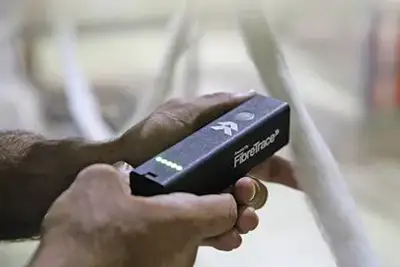
The Stathams, who are also the owners of Good Earth Cotton, founded FibreTrace in 2018 to keep track of their carbon positive cotton throughout its transformation in the textile and apparel supply chain. After investigating existing technologies, they chose a solution based on a luminescent pigment, the same found on currency and passports. It patented a process that is said to withstand all manufacturing stages. Initial trials were conducted on cotton grown on the farm, made into a denim fabric used by Australian jeanswear brand Nobody Denim, which launched a first fully traceable range last year. “If it survives the many manufacturing and finishing stages of denim, it will survive anywhere,” says FibreTrace CEO Shannon Mercer. The pigment can be applied to cotton, viscose, polyester, and recycled versions of these. The company is close to finalising an application process suitable for leather, and tests on wool are ongoing, in which case the pigment would be added during scouring. After the placement of this physical marker, the other stages of a material’s transformation are provided by each company involved in its manufacture or logistics, the data is stored in the cloud, and copied and secured in a blockchain.
The Movement is transposing a technology developed by Circularise, a spin-off of the Delft University of Technology, from plastics to textiles. “Our founder, Feico van der Veen, was involved in this research programme,” says Koen Warmerdam, brand director. Aware was launched in March last year with a dozen spinners specialising in recycled yarns. It uses different types of nanoparticle- based tracers, which are embedded in recycled cotton or recycled polyester yarns. The presence of the marker can be measured by a tablet or spectrometer. When a company places a purchase order, of say, 50,000 kg of yarn, it will receive 50,000 blockchain-backed tokens. Aware tracer material is added to the sustainable feedstock and 50,000 tokens are registered on blockchain. The yarn is now guarded and can be brought into a supply chain of the final brand. Final products are delivered to the company for a tracer detection test. After a positive scan, it issues a Certificate of Authenticity and transfers the tokens to the wallet of the final brand. Final brand then has access to all traceability data, including all certificates and impact data report. This, he says, avoids the risk of greenwashing. It is better than QR code-based tags that can be falsified, as revealed last year in improperly labelled organic cotton made in India.
Swiss start-up Haelixa has chosen a DNA-based marker, which has been approved by GOTS for application on organic fibres.
Cashmere specialist FTC Cashmere has adopted the system to provide additional guarantees on the authenticity and origin of its luxury fibres. Cashmere is similar to organic cotton in that the number of cashmere products sold yearly is believed to exceed the amount of fibre produced in the world.
Data on product and impact
These platforms provide multiple services related to supply chain management and efficiency, but the main driver for adoption by brands seems to be sustainability, and drawing the attention of consumers, future employees, possibly even investors, to their commitments. This is why a new layer of data is being added, beyond basic sustainability certifications, to indicate a product’s carbon footprint and thus generate engagement and trust from these stakeholders at large.
A new venture within Avery Dennison, atma.io, builds on the Glendale, California-based group’s existing labelling infrastructure with the integration of new digital capabilities. It launched in March 2020 with adidas as part of the sports brand’s sustainability strategy and resale platforms. The atma.io cloud already traces some 10 billion digitised items, and 50 more are added every second, says Max Winograd, VP, connected products, Avery Dennison Smartrac and atma.io co-founder. The system tags and monitors each individual product, down to the right and left foot of a pair of shoes. It can use any type of “digital trigger”, including serialised QR codes, RFID, common in supply chain management, and NFC, more often used for authentication and consumer engagement.
Offering new tools for recommerce, or reverse commerce, and facilitating recycling are a key focus for CircularID, a digital tracing protocol developed by Eon Group, a company founded in 2015 and based in New York City. It is specifically designed to “share data across the entire lifecycle of a product, from maker to seller, consumer, reseller and recycler,” company founder Natasha Franck, tells WSA. A pilot programme for CircularID was made available last year and a scaled up – 1.0 – version should be ready later this year. It too can use any type of smart tag that is attached to a product at the cut-and-sew stage. “We can associate data from earlier processes into the platform, but we do not apply a marker on the raw material,” she says. Each individual product will, however, have a unique identity and digital twin. Brands trialling the system include For Days, Yoox Net-à-Porter (YNAP), Outerknown, Gabriela Hearst and Houdini (as reported in WSA Issue 1, 2021).
In the absence of a standard tracing framework covering all supply chain needs, these companies have for the most part made their platforms open and inter-operable. “Brands can use any blockchain they wish, our system is very open, as our goal is to create the connectivity,” says Ms Franck. “FibreTrace is an agnostic, open-source system,” says Mr Mercer, it can be associated with other certification schemes and databases. Aware can add information related to social compliance to its interface, and it is considering the integration of CRM and ERP that major brands use, says Mr Warmerdam.
Sharing costs
In addition to sharing data, these new platforms also believe that the cost of their services should be shared by users across the supply chain. “Transparency shouldn’t have to cost the earth,” says Mr Mercer. He believes FibreTrace adds less than 2 cents on a T-shirt, and says it can lead to higher sell-through rates. Aware supplies the tracer and sells tokens representing the volumes tagged. The Movement invoices a percentage to the nominated spinner and to the final customer, brand or retailer, the remaining amount based on quantities purchased and number of tokens. “We have designed this system to keep the price of yarn as low as possible,” says Mr Warmerdam. He estimates that it can add 2-3% to the cost of a finished product. In the low margin business of textiles, these companies say they want to enable farmers and spinners to invest in better practices.
Carbon and bottle counting
As Mr Warmerdam points out at Aware “spinners are the ones that are innovating, increasing recycled content and the quality of yarns.” Many a sustainability claim relies on the recycled or organic nature of a fibre or filament. Greensboro, NC-based polyester producer Unifi adds a marker to its Repreve-branded polyester recycled from PET bottles or ocean plastics. This allows a brand to request “bottle counts” for the products made from these yarns.
It is then relatively easy to calculate a product’s environmental impacts. “We add LCA data information to a material’s profile on blockchain based on validated LCA data,” says Mr Warmerdam. These resources are also being harnessed by atma.io, down to distance travelled and method of transportation used, captured and communicated on its platform. Consumers can gain added insight into their own carbon footprint, and the potential impact of using it more or reselling it, says Mr Winograd.
This is the reasoning behind tracing each individual product. “Once you take into account usage at consumer level, every product has a unique lifecycle. Also, a system that follows a product’s entire lifecycle will be able to indicate whether it has been recycled or not. This is not an important issue in a linear economy, but it is essential in a circular economy,” says Natasha Franck.
Not only do these technologies streamline services that in the past were difficult to obtain or impossible to certify, but they are also providing product-level environmental information in an easy to access format. There is arguably room for improvement in the quality of the datasets used to calculate impacts, but it can also be argued that any form of transparency reduces the risk of greenwashing. These smart-tagged products and cloud-based platforms are bringing clarity to an opaque supply chain and they are doing so, not just SKU by SKU, but more granularly, one shoe at a time.
The LEDs on FibreTrace’s handheld spectrometer display the proportion of tested material that has a marker (shown here at a gin). “If a bad player adds 50% conventional cotton to a fabric labelled 100% organic cotton, the signal will indicate it, without having to send a sample to a lab,” says Shannon Mercer, FibreTrace CEO.
CREDIT: FibreTrace


