


Unwanted legacy: chemicals in textile waste
Hazardous chemicals in textile waste has slipped under the radar for many promoters of a circular economy. A study into this issue finds risk to be low, but real. It brings to light the need for more research and increased traceability, but also brings into question the evolution of standards, and may introduce a new snag in the possibility of closing the loop.
Unwanted legacy: chemicals in textile waste
There are known barriers to closed-loop recycling of fibres into fibres. There is, for one, the low cost of virgin raw materials. Secondly, there is a lack of infrastructure for large-scale sorting and pre-processing of textile waste, despite progress in mechanical recycling. A third stumbling block is the possible presence of hazardous chemicals in material intended for a second life.
This known unknown inspired H&M Group and Ikea to launch a study on the presence of hazardous chemicals in used textiles. This is a necessary step if they are to meet their stated goal to use 100% recycled or sustainably sourced materials by 2030. The findings of this research project, begun in 2019 and expanded in 2020 with a new set of industry partners, will be used to create a databank that will be shared within the industry and with legislators.
The study tested three fibres, cotton, wool and polyester, from samples collected in Europe, the US and Asia. For the most part, the thousands of tests conducted showed that no regulated substances were found to exceed accepted limits, based on the restricted substances list (RSL) of the Apparel and Footwear International RSL Management (AFIRM) group, a widely recognised resource. Of the 172 cotton samples, 99.97% passed and in 98.23% of the samples, no restricted substances were detected. Harmful chemicals were found to be above accepted limits in eight instances out of a total of 24,700 analyses.
For polyester, 99.3% of 169 samples passed. For this fibre, 85 substances were found to be above accepted RSL limits. Of 154 wool samples, 98.5% passed. Here, however, 216 tests found levels to be above accepted limits. In 145 instances, NPEOs (Nonylphenol and Nonylphenol ethoxylate) were found to exceed RSL limits. “Although the overall fail rate was low, the failures were spread over many samples,” say Negin Farhadi, H&M’s project manager for recycled textiles, and Mirjam Luc, project leader for recycled textiles at IKEA.
At first glance, these results could be considered reassuring. In the vast majority of samples, no restricted substance was detected, and any that were present remained under accepted limits. However, the report confirms that textile waste can be tainted by chemicals of concern. Formaldehyde showed up in many wool samples, the APEO is a group of surfactants (covering NPEOs and OPEOs) and heavy metals were found across all three types of fibre. The enduring presence of APEOs, used in detergents, scouring or wetting agents, dye-dispersing agents and spinning oils, could be problematic. “Nonylphenol ethoxylates, or NPEs, pose no risk to consumers of apparel and footwear, but they degrade into nonylphenol (NP) in wastewater systems and in the environment,” says AFIRM’s director Nathaniel Sponsler. NP is considered persistent in the aquatic environment, moderately bio-accumulative, and extremely toxic to aquatic organisms. Legislation around the world restricts the presence of APEOs in finished goods.
How and why they turn up is an open question. Their presence may not be intentional. The precise formulation of chemicals used in the textile and apparel industry is not always known. A harmless substance may become harmful in some conditions. It is also possible that the textile waste comes from clothes made at a time when there were fewer restrictions.
The H&M and Ikea project confirms that this issue needs to be addressed. “Any chemicals hampering recycling and material recovery should be restricted,” insist the study leads. The findings, they say, will be used to establish “an acknowledged and harmonised hazard assessment methodology for chemicals used in production”.
Few companies have the means to conduct tests on the scale of the H&M and Ikea study. French sports retailer Decathlon spends €10 million every year to check that its products are safe for consumers, workers and the environment, said Maxence Dubus, chemical safety manager, at a recent conference, organised by the French National Institute for Industrial Environment and Risks (Ineris), on hazardous chemicals in textiles. The retailer says it now uses BHive, a chemical scanning tool and app developed by GoBlu International, to monitor the presence of chemicals in its goods.
Safety, an ever-evolving notion
Among its findings, the study brings to light the evolution of chemicals regulation policies. “The number of restrictions for chemicals has grown from only one in 2014 to over 5,000 in 2022,” said Carole Mislin, Archroma’s head of global product stewardship, speaking at the same Ineris conference.
The definition of what is safe keeps changing, says AFIRM group director Nathaniel Sponsler. “A substance that was perfectly legal a few years ago may become illegal at a later date, or the residual amount allowed in a product may be substantially decreased by new regulation. This means that a material manufactured today may face stricter rules later that would not allow its use in new products.”
The EU is in the process of potentially adding over 1,000 new restrictions, of which 20% are thought to be relevant to the apparel and footwear industries, says Mr Sponsler. “Some of the new guidelines bring allowed levels down to parts per billion (ppb).” These difficult-to-detect trace amounts could have an impact on the recyclability of used textiles.
As new data emerges on the presence of hazardous chemicals in used textiles, new questions will emerge. “It may be possible to wash out some of the unwanted, or now illegal, chemicals. But that may require a lot of water, energy and additional chemicals, and may not be sustainable,” says Mr Sponsler. This situation raises another set of questions. “Should specific rules be set for recycled content? A separate RSL could be developed for recycled materials, but would it meet basic market requirements?” he asks.
Textiles are not the only source of concern, as polyester recycled from post-consumer PET bottles has been found to contain trace amounts of Bisphenol A (BPA). “All possible sources are being investigated, but early indications are that it could come from polycarbonate bottles mixed in with PET plastics,” says Mr Sponsler. If that were the case, it would be necessary to implement finer sorting processes to keep polycarbonate bottles out of PET feedstock or treat the solution to filter out the BPA. “We are learning as we go,” he says.
Chemsec, like AFIRM, was consulted by the Ikea and H&M research team. “Chemsec reviewed the findings, and we commend it as a great example of collaboration for good. There is a huge lack of information on recycled textiles, and this is an attempt to fill that gap,” says Chemsec senior policy advisor, Theresa Kjell. The environmental NGO, based in Sweden, advocates for the removal of hazardous substances from consumer goods.
“I was surprised that the results were so good for cotton. This issue of chemicals in waste textiles is not problem-free, but slightly better than expected,” she says. Azo dyes, for instance, did not show up. “This confirms that regulations have an impact.”
Tracing chemicals
The data provided by H&M and Ikea makes clear the need for more information on chemicals used in the textile industry. In addition to providing recyclers with the go-ahead to recycle identified waste, it could also increase the value of used textiles, says Ms Kjell.
Traceability systems currently tend to focus on tracking fibres throughout the supply chain. Few include data on chemicals.
Toxnot, a company founded in 2016 and based in Fort Collins, Colorado, has chosen to include chemicals in its software platform. It compiles data to create a material passport for the textiles used in apparel, furniture and architecture for companies seeking to address compliance, sustainability and circularity goals. The advantage of software over a paper-trail is that “there is no limit to the possibilities of software, whereas there is only so much room on a paper trail,” says Peter Girard, CEO and founder of Toxnot. “Brands try to do good, and we are working with them to achieve this. But the industry does not have the tools to screen chemicals used to make their products. We are filling a gap,” he says.
In circularity, he says, there has been a lot of focus on recycling and not much on chemistry. To support the addition of sensitive data to its traceability platform, Toxnot allows companies to make ‘blind’ information they do not want to share if they feel this is necessary to protect intellectual property. They can decide what data will be made available to whom. Recyclers may be given access to information on chemicals that would otherwise be restricted.
How toxic is textile waste?
For those engaged in promoting circularity and mechanical recycling of textile waste, the presence of hazardous chemicals is, unsurprisingly, a cause for concern. But so are the escalating quantities of unwanted clothes, which have possibly been worn and washed for years before being discarded. “This is clearly an important issue. Yet, we need to recognise that we collectively produce a tremendous amount of post-consumer material. In my mind, it is better to recycle it than send it to landfill,” says Accelerating Circularity founder Karla Magruder. This point of view may well be shared by the many companies specialising in the reuse, resale or rental of secondhand clothes. These are not known to be subject to chemical testing or to any specific standards.
“The Ikea and H&M study shows that the risk profile is not so high for post-consumer cotton textile waste as maybe originally thought,” says Helene Smits, chief sustainability officer for Recover. A global producer of mechanically recycled cotton, Recover was founded by 70-year-old Spanish spinner Hilaturas Ferré and spun off as an independent entity that US private equity firm Story3 acquired in late 2020.
The company recycles cotton textile waste into fibres that it sells to spinners, who most often blend the recycled material with other sustainable fibres. “Our products are all certified Oekotex 100 class 1. We test them at 100% concentration level, meaning 100% recycled content, to guarantee they do not exceed accepted levels of detection,” says Ms Smits.
Recover currently processes post-industrial waste for some 95% of its business, which Ms Smits says is expected to be REACH compliant, whether produced in Europe or elsewhere. The remaining 5% of its production is cotton recycled from post-consumer jeans.
In both cases, the material processed by Recover comes from various sources and is never the same. As testing feedstocks once a year will not give a true picture, it tests random samples twice monthly “to uphold our certification,” says Ms Smits. The company has started to test every lot for specific chemicals on top of that. For post-consumer fibres, it takes samples from multiple places in one lot and mixes them to get a good average sample. “If we sampled from a single area, we could be lucky or unlucky,” she says. This raises the question of whether post-consumer waste, heterogenous by nature, should require different testing protocols. “We need standards that ensure safety and that allow us to keep costs manageable,” she says.
Stripping out chemicals
Chemical recycling is often cited as a possible solution to avoid finding toxic chemicals in textile waste, as feedstock is dissolved and problematic substances could then be filtered out. But the Technological Readiness Level (TRL) of chemical recycling processes is low, from three to six, on a scale of nine, says Jeanne Meillier, project manager at French material innovation and sustainability cluster Euramaterials. “Mechanical recycling is much more advanced, and has greater economic potential,” she says. She also notes that mattress recyclers sanitise used goods to neutralise pollutants before recycling.
The presence of commonly used and legal dyestuffs has been found to adulterate mechanical recycling processes. The EU-funded Retex recycling programme that Euramaterials led met one such hurdle in its polyester textile value chain. “During the compounding process, which uses heat and pressure, colours were found to sublimate,” says Ms Meillier. An orange shirt would turn khaki green once compounded, and sometimes blue and yellow combined to produce green. “This is not something that can be controlled,” she says, as many different chemicals are applied to polyester clothing, including sizing agents, surface treatments and dyes.
Various methods to strip away dyes from waste, using supercritical CO2 or ozone, could be an option for removing unwanted substances, and increasing the value of recycled feedstock. But these, says Ms Meillier, can be energy-intensive. Lei Yao, director of product development at Hong Kong-based textile research centre (HKRITA), agrees that supercritical water could be a solution for handling harmful chemicals removed from textile waste. “It is a very powerful and efficient technology, but there are lower-cost methods,” she says.
HKRITA has recently finalised a study on the decolouring of polyester textiles. It has found that a combination of high temperature, high pressure and water “makes the polyester fibre swell and release its colour,” Lei Yao tells WSA. Activated carbon is then used to absorb the discharged dyes. “This process does not affect fibre quality, and it is not very expensive,” she says. Though it sounds simple enough, Ms Yao admits there are some challenges. “The system works well on some dyes and not on others. We need more comprehensive studies of different dye families.”
This circles the issue back to the initial question that the H&M and Ikea project was looking to answer: what chemicals remain lurking in a random bale of discarded, no longer wearable clothes? The chemical experts consulted tend to insist that legal limits are legal limits and, to be put onto the market, any recycled product must be guaranteed to be safe.
But they also intimate that as regulations become ever more stringent, it may become near impossible to find feedstock suitable for mechanical recycling. “It will be challenging to tackle the issue of legacy chemicals, but developing closed waste streams is one way to decrease the problem, as open ones could be too contaminated,” says Theresa Kjell, at Chemsec.
For those that promote mechanical recycling, as Karla Magruder at Accelerating Circularity does, it is commercially viable and should be encouraged. “It will support the development of sorting and pre-processing technologies. A recycler should be able to say, I need this and don’t want that, and be able to place an order that meets its standards,” she says.
The two camps agree on one matter: the need to phase out hazardous chemicals from the start instead of having to remove them afterwards.
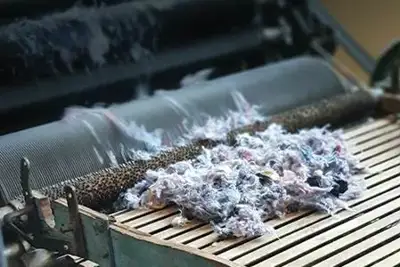
Textile waste was first shredded before undergoing tests in the H&M and Ikea project
Credit: Ikea Sweden


