


New momentum for smart textiles
Two accelerator and innovation programmes, SmartX and SmartEEs, believe collaboration is key to unlocking opportunities in smart textiles. Promising projects selected by these platforms have access to a network of research centres, consultants in textiles and electronics, along with potential business partners and investors.
The global market for smart textiles is expected to reach $3 billion by 2024. This positive outlook draws on a 2021 smart fabrics industry report by Grand View Research. Yet the large and small companies operating in this field in Europe face obstacles in the development and scaling up of their innovative and connected products. This is what SmartX and SmartEEs, two incubator and accelerator programmes for smart textiles, have been focusing on throughout their three-year mission as part of the European Commission’s Horizon 2020 fund.
“Independent research firms believe the smart textile market will grow 80 times faster than the traditional textile and apparel industry,” says Lutz Walter, SmartX coordinator and secretary general of the European Technology Platform for the Future of Textiles and Clothing (ETP). “But the greatest challenge this sector faces and the reason why many prototypes do not reach the market is a lack of a strong value chain.” Filling the gaps in the supply chain is precisely what SmartX has sought to address by supporting the SMEs that have the know-how “to fill the gaps”. In this way, it aims to enable Europe to be a world leader in smart textiles. SmartX estimates that the development of these new value chains could represent a market opportunity of €5.5 billion in 2026, if a viable industrial ecosystem is developed to meet potential market demand for smart textile-based solutions.
The two programmes share a similar mission and vision. “SmartX funds smart textiles projects that are based on a real manufacturing supply chain, have been tested in a real environment, have a solid business model, and, ideally, are textile-based. These are all necessary for the creation of a viable supply chain in Europe,” says Mr Walter. SmartX was given a budget of €2.4 million that it distributed to 40 smart textile projects. Each one received up to €60,000, including access to coaching sessions. For its part, SmartEEs had a budget of €8 million to support companies developing flexible and wearable electronics. As its second three-year mission has come to a close, it has set up a new structure in Belgium, the European Flexible and Wearable Electronics Association, to keep the programme dynamics going. “The two are quite complementary, with very few overlaps,” Jérôme Gavillet, head of the SmartEEs project tells WSA.
Both programmes enlisted a wide range of research centres to provide the start-ups with technical support. These include Centexbel in Belgium, Citeve in Portugal, the Smart Textiles science park of the University of Borås in Sweden, the Deutsche Institute für Textil in Germany, to name just a few.
To foster interaction and collaboration, SmartX organised a series of events, workshops and hackathons throughout Europe. The two accelerator programmes joined forces to present their final round of funded projects at the Institut Français de la Mode (IFM) in Paris in late November. The event was an opportunity to discover a selection of ongoing projects for sports applications and provides a picture of the state of next generation smart textiles developed in Europe. The final event for SmartX will be held in Brussels, on April 20 and 21, if conditions allow, in conjunction with the ETP’s annual conference.
Promising projects
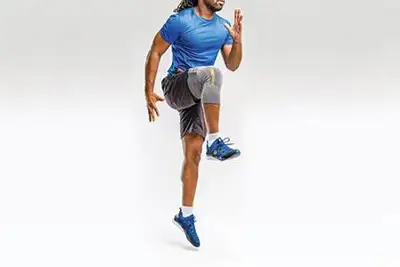
Originally based in New Zealand, and now headquartered in the UK in Nottingham, Footfalls & Heartbeats specialises in knitted textile-based sensors. Within the SmartX programme, the company focused on optimising its motion-tracking knee sleeve, KiTT, specifically improving the sensor response and removing anomalies in data collection. It was able to work with Ioetec, a data security specialist based in Sheffield, and with Revolve, a Katowice software company in Poland.
Three types of sensors, knitted directly into the smart sleeve, measure pressure and strain, and collect bioelectric measurements such as heart rate, electrocardiogram (ECG) and electro- myography (EMG) data. “The knitted structure itself is the sensor, it is a unique technology,” says Dr Andrew Garland, Footfalls & Heartbeats CEO. “The sleeve measures joint movement directly; we do not infer data. This allows us to capture high-accuracy gait count and to monitor parameters that indicate a state of fatigue or help optimise performance.” The smart textile technology has already been used and validated in mattresses, car seats and socks, which can have up to 12 different sensors, he says. “Sports shoes now often have knitted uppers, we could knit in sensors to measure users’ gait cycles,” he says.
Sweat monitoring
Swemax is a sweat-monitoring smart top and an evolution of a previous project known as Biometrica, first developed by a research consortium with the University of Padua in Italy. The concept includes an egg-shaped electronic module that clips onto a biosensor pad, and communicates biological data in real-time to a smartphone app. “By monitoring sweat, we can extrapolate water or mineral loss during intense sports activities such as running and cycling. Exhaustion can lead to cramps, mental confusion, even blackouts,” says Klaas Van de Velde, project lead through his Belgium-based business development and marketing company, WorldKlaas. This insight can be used by an athlete to optimise hydration and salts reintegration, improve fitness condition and preparation for competitions.
During the SmartX accelerator programme, the size and weight of the ‘egg’ was reduced by 30%. The biosensing patch was enhanced in terms of sensitivity and stability. Italian knitter Staff Jersey was enlisted to develop the seamless and close-fitting tank-top which holds the electronic components. Several prototypes were developed and tested with athletes. With these developments, the company says its current iteration is now market-ready.
Training and posture guidance
Pikku Active promises to deliver AI-based training assistance using smart textiles. It is part of a platform of training devices and programmes for professional athletes developed by Blautic, based in Valencia. During the accelerator programme, it was able to develop new smart textile-based features such as textile electrodes that capture EMG signals. The movement and muscle activity data is then sent to a smartphone app. The company has paired up with research and innovation centre Aitex to design the smart textile, active sportswear manufacturer Atika Sports, and Life Fitness House, all based in Spain, the third providing validation of the training assistance technology.
“The system is designed to be used by trainers, clubs and physiotherapists. It can measure a person’s condition before and after hip surgery, for instance, to ensure a person recovers the same mobility after surgery,” says Javier Soriano Falco, Blautic founder and CEO. The company is also investigating possible applications in virtual reality gaming to encourage physical activity in the metaverse.
Designed for industrial uses, but having possible sports applications as well, Dynaback is a smart posture-monitoring top. Developed by Bulgaria-based Madesign, it has five sensors placed along the spine that measure upper body movement for musculoskeletal monitoring. This direct and automated monitoring of position was found to provide superior data compared to traditional motion-capturing technologies, company founder, Sabri Mahdaoui, tells WSA. Part of both the SmartX and SmartEEs platforms, the start-up teamed up with German textile tech company Amohr, which provided the conductive tapes, improving on an earlier wire-based connecting system.
The Dynaback T-shirt captures a user’s body movements and sends an alert whenever irregular movements occur. The company believes its products will also help better understand the reasons for musculoskeletal problems, in addition to protecting workers. The project is fairly advanced, and has already begun to manufacture runs in the 100,000s, with ongoing tests in Bulgaria and France, says Mr Mahdaoui. “The challenge is not the technology, the technology works; the challenge is bringing value to the user,” he says.
Many other SmartX and SmartEEs-backed projects targeting health, sports and industrial applications were featured during the two-day event in Paris. The projects described here are just a tip of the iceberg, and they are roughly in a similar state of development and market readiness. They confirm the importance of collaboration but also the existence of a strong network of companies across Europe with expertise in smart textiles, electronics and software. These pan-European networking programmes may have thus found a way to unlock some of the barriers to bringing these innovative smart textiles to market.
Developed by Footfalls and Heartbeats, KiTT monitors joint movement in real time, providing useful data to athletes and physiotherapists.
Credit: Footfalls & Heartbeats (UK) Ltd


