


Biodegradable breakthrough
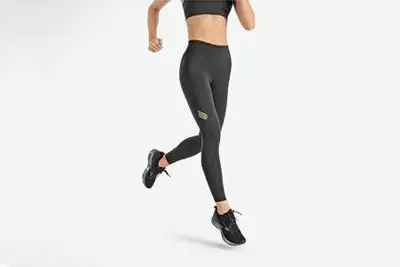
New synthetic yarns that biodegrade in landfill hundreds of times faster than ordinary polyester have caught the eye of running apparel brand Pressio.
It may seem to fabric manufacturer Paradise Textiles that recognition of its achievements has been slow to arrive even though, ironically, speed is the big selling point of its latest breakthrough. The company, which has its headquarters in Taiwan and its main production facility in Wuxi in China, had been operating and supplying some big-name apparel brands with fabric for 25 years before it caught the attention of the ISPO Textrends international jury in the autumn of 2021.
This selection panel compiled its list of the best products for spring-summer 2023 and included Paradise among the winners for its BioFuze fabric. Constructed from 55% biodegradable polyester (PET) and 45% biodegradable polybutylene terephthalate (PBT), BioFuze earned the jury’s praise as “one of the world’s first synthetic fibres that returns to earth hundreds of times faster than ordinary polyester”.
In its presentation of BioFuze, Paradise Textiles points out that ordinary polyester garments probably take hundreds of years to biodegrade in landfill, but it says its new product is not ordinary polyester. Tests that a specialist New Mexico-based operator, Eden Research Laboratory, has carried out suggest that after 30 days in a regulated landfill environment, a garment made from BioFuze will have begun to attract micro-organisms that accelerate the process of biodegradation.
After 100 days, the garment will have begun to show a reduction in mass and by the time 200 days have passed, 45% of the garment will have biodegraded. In a little over another month, it will be 70% biodegraded and the process will continue until only biomass, water and some methane remains. According to Paradise, in a regulated landfill environment, it should be possible to capture that methane and use it as a source of energy.
Paradise applies an additive to achieve all this. It does this when it makes the chips and the biodegradability is then something permanently embedded into the fibres when it extrudes them. It is this additive that attracts the micro-organisms in landfill and binds these to the yarn to allow them to go about their work of breaking down the fibres, speeding up the natural process, but without causing the fibres to fracture and break down into micro-plastics. Instead, conversion of the fibres into water, methane and biomass takes place at molecular level.
Quick off the mark
Compression-enhanced athletic clothing brand Pressio has wasted no time in incorporating Paradise’s biodegradable polyester fabric into a new collection of performance apparel, Pressio Bio. Launched in 2021, the brand is the brainchild of Jamie Hunt, one of the founders of the 2XU brand. For him, the appeal of biodegradable products is that they are part of an aim to make every aspect of the business fit its sustainability model. There is great interest in recycled material, but what happens to garments at the end of their useful life is what he refers to as “the missing link”.
In an ideal world, it would be possible to use materials time and time again, with nothing going to waste, but while we wait for those days to come, biodegradation is a better end to the product lifecycle than much of the apparel industry can offer at the moment. Mr Hunt explains: “Ultimately, our goal is to have solution-dyed products, recycled products and biodegradable, all in one. We’d love it if everything could be recycled right now, but I think we all know that’s not going to happen at the scale required for a very long time.”
He contends that Pressio will work to add “piece after piece to the jigsaw”. Next year, for example, it will introduce biodegradable garments that have been constructed using fabric made from recycled polyester. And meetings are already taking place between the brand and textile suppliers that are working on bio-based yarns with similar properties, in terms of such as moisture management, to synthetic fibres. “We are working towards bio-based yarns that will, in future, offer the same qualities as synthetic yarns,” he explains, “but at the moment, the best option we really have is to get PET from water bottles. That has to be better than taking it from oil. We’re also trying to eliminate any garment dyeing because that has an impact on waterways that will take hundreds of years to solve.”
First mover
Jamie Hunt says he spends most evenings watching television, but with his phone or his computer to hand to be able to read about breakthroughs in textile science, researching new technology. One evening, following up on a notion to introduce biodegradable yarns, he came across Paradise Textiles. “I got in contact with them and started talking to them about what they had developed,” he explains. “In my eyes, it was clear that Paradise, with what it was doing with BioFuze yarns, was a leading company in this. One of the beautiful things about Pressio being a small, agile company is that, within four weeks, we had some samples made up, which we tested. Within ten weeks we had fully developed our product. We believe we’re the first brand in the world to be using it, which is very exciting for us. The results are quite phenomenal.”
Pressio Bio running tops and T-shirts, were soon on sale in important partner retailers, ranging from the sport-specific Run And Become to the world-famous Harrods in London. Pressio has given the name BioSol to the fabric it has made using BioFuze yarns, using a dual-filament construction to provide the tops with permanent moisture management to keep runners cool and dry. The tops also have anti-bacterial treatment from Rudolf.
Bottoms in the collection use a version called BioSol Power 37.5, which, as the name suggests, incorporates technology from Colorado-based 37.5 alongside yarns engineered, by the same process as described, to biodegrade at enhanced rates in landfill. With this, active particles permanently embedded at the fibre level, capture and release moisture vapour to prevent sweat from forming and help cool wearers down when they are hot. The same active particles trap energy to warm them up when they are cold. Jamie Hunt, who moved six months ago from New Zealand to a new base in London says he had been hearing good things about 37.5’s technology for years and was confident it would work well. Wearing some of the BioSol Power 37.5 running tights to help him endure his first winter in the UK has proved that this confidence was well founded. He says: “I know there can be some cynicism around heating and warming technologies, but I have tried it in freezing cold London weather and the heating aspect definitely does work.”
Maximum performance
He calculates that the biodegradable properties could add between 20%–30% to the cost of the fibre, but points out that this translates to an increase in cost of a final garment such as running tops that should be closer to 10%. Adding thermoregulating properties to the biodegradable yarns in the bottoms adds a little more. He does not regard this as “a massive increase”; a much more serious problem to overcome is limited availability of the technology. He would like it to become more easily available and for more brands to begin using it. “We want a sports performance industry in which properties such as biodegradability are part of the norm,” he says.
Mr Hunt’s belief is that one of the most difficult challenges that brands face in creating new sports textiles is that natural fibres cannot deliver what he calls “maximum performance”. He views this as unfortunate and adds that he would love to be able to use cotton or wool, not least because these fibres break down much more easily at end of life. “But we just can’t,” he says. “They do not wick moisture; cotton and wool both hold on to moisture. There is nothing out there at the moment that is going to mimic what we get from synthetic fibres.” He says this is the reason his brand is interested in developments such as bio-based yarns that will offer the same performance, plus natural biodegradability, but warns that these products may still be four or five years away. “That’s the future,” he says, “but right here, right now, we’re really happy with the results that we are seeing with the fabrics we are using for this biodegradable collection.”
Fabric made from biodegradable synthetic yarns, enhanced with cooling and warming technology from 37.5, feature in the new Pressio?Bio running tights.
All Credits: Pressio


