


Second chance for circular suede
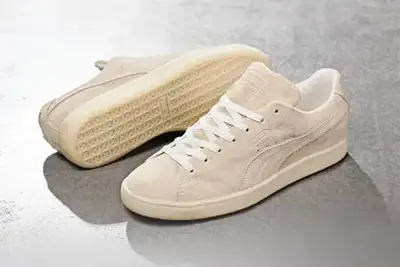
Puma has launched an experimental shoe collection that will test strengths (durability) and weaknesses (biodegradability) and determine if industrial composting could create value as fertiliser at the end their useable life.
Admitting failure is often tricky, but Puma says its foray into circular designs in 2012 with the InCycle Basket initiative did not work out as planned. At the time, the German sportswear company believed the way to create a compostable shoe was to make its classic Puma Suede design from materials including linen and organic cotton, with a sole made from a biodegradable plastic called APINATbio. There were questions over the environmental profit and loss system that was used to compare the suede and InCycle Basket shoes, and these initial figures were missing from the commercial launch in 2013. Despite the ambition, InCycle collections were dropped after four seasons due to a lack of demand and the realisation that more research was needed.
“In 2012, our circular ambition was bold but the technology wasn’t quite there,” admits Heiko Desens, Puma’s creative director. “As they say, with every challenge there’s an opportunity and we’ve continued to push ourselves to do better by applying our strengths as well as acknowledging and improving on our weaknesses.”
Puma has now returned to suede with the launch of another initiative designed to test biodegradability and circularity. Puma Re:Suede is the first concept from its new Circular Lab. The pilot project involves 500 pairs that have been designed to be disassembled and will be sent to users in Germany this year to be tested for durability over six months.
After this, testers will pilot a new “takeback infrastructure” to send the shoes back to Puma and on to Valor Compostering, owned by Ortessa, a family-run group of waste specialists in the Netherlands. Here the shoes will undergo an industrial biodegradation process to determine if Grade A compost can be produced for agricultural use. “There is a lot more we can all be doing to help tackle waste management, but taking on that challenge alone can be a difficult task for any brand,” says Ortessa CEO Rob Meulendijks. “We are delighted to be working with Puma on this special project.”
Tanning advances
Central to the switch back to suede in terms of circular thinking is a novel tanning process called Zeology, brought to market by Dutch leather chemicals manufacturer Smit & Zoon and its nascent Nera division. The system is based on the mineral zeolite and is chrome-free, heavy metal-free and aldehyde-free. Tanners around the world, and organisations such as the New Zealand Leather and Shoe Research Association and the University of Northampton’s Institute for Creative Leather Technology in the UK have been among those to test the product over several years.
Smit & Zoon CEO Hans van Haarst told WSA’s sister publication, World Leather, that Zeology has the potential to be “a gamechanger for the leather industry”. “We’ve made upholstery leather for furniture, for aviation, for automotive, for garments, for footwear and for leathergoods,” he says. “We’ve used different raw materials and we’ve conducted trials at 36 tanneries.
“Furniture and automotive brands definitely want this and luxury group Kering has already made public statements about insisting that its leather suppliers remove heavy metals from the tanning process [Kering owns around 10% of Puma’s shares]. We are convinced this product fits with that.”
Leather made using Zeology has a tight grain and high tear-strength and tests have shown shavings to be almost as compostable as pure collagen. At least 10 tanneries now supply the product, including Heller-Leder, Südleder and Gmelich & Söhne in Germany. Puma says its tests show the Zeology suede ensures better comfort for the wearer compared with the other biodegradable materials it evaluated. The outsole of the Re:Suede has also been improved to ensure optimal wear.
Waste reduction
While the pandemic caused problems for most businesses, Puma forged ahead with plans set out in 10FOR25, an evolution of its previous sustainability strategy. The Puma Re:Suede initiative will show how well the takeback scheme works in Germany, with a view to expand this to all major markets. The 2025 target is to reduce production waste to landfills by at least 50% from a 2020 baseline, and 90% of all footwear should contain at least one “more sustainable” component, compared with around a quarter now.
Following tough periods in 2020 and the start of this year, Puma increased sales by 20% in the third quarter to €1.9 billion. Despite the covid-19-related lockdown of production in Vietnam, an “overheated” freight market, port congestion and a difficult market situation in China, the outlook for the industry, and for Puma in particular, is very positive, the company stated.
It aims to share the insights gained from the Re:Suede project within the industry to achieve a bigger impact. “We hope that progress made during ‘No Time For Waste’ will help us continue to raise the bar in circularity testing,” concludes Mr Desens, “enabling our consumers to make better fashion choices in the future, so their sneakers can go ‘from suede to soil’, without compromising on product style or durability during ownership.”
The Puma Suede was first launched in 1968. With the Re:Suede, the company wants to give its consumers a more sustainable choice, while showcasing the latest technologies.
All credits: PUMA


