


Lawmakers take on fashion
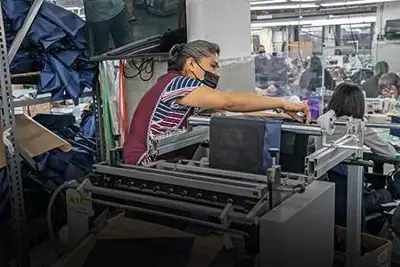
Can two proposed bills — one state and one federal — harness US law to mitigate fashion’s social and environmental impacts globally?
This year, the men and women of the US’s legislative bodies have had a lot to say about fashion. It started in January, when New York’s Senator Alessandra Biaggi and Assemblywoman Anna R. Kelles announced they had introduced the Fashion Sustainability and Social Accountability Act (the Fashion Act), to the New York state legislature. Then, in May, US Senator Kirsten Gillibrand introduced the Fashioning Accountability and Building Real Institutional Change Act (the FABRIC Act) to the US Senate.
Put simply, the Fashion Act addresses fashion’s environmental and social impacts across all aspects of its global supply chain by targeting any brands that do significant business in New York, whereas the FABRIC Act focuses on wage protection for garment workers within the US and encourages the reshoring of manufacturing jobs. The Fashion Act is a proposed state law enforceable only in New York and the FABRIC Act is a proposed federal law, which is enforceable throughout the entire country, although, in a global economy, both have reverberations across the globe.
As details of the new bills underwent greater scrutiny and those affected began taking their stances for and against, a Forbes article in June asked: “Have the proposed FABRIC and Fashion acts poked the US retail bear?” To what extent the bear has been poked will not be fully known until at least next year. New York’s legislative session will not be back in session until January, and the federal FABRIC Act is in committee, a place from which many bills never emerge.
But Misbah Farooqi, communications director for Senator Biaggi, has told WSA that amendments to the Fashion Act legislation will be released soon, and proponents of the FABRIC Act are aiming to pass and implement the act as law in 2023. So, things seem to be moving. Despite the inevitable debate and delays each is certain to undergo, proponents of both pieces of proposed legislation feel that now is the time for increased oversight and regulation of the fashion industry and its people, processes, and products.
The Fashion Act
The legislative backgrounder for the Fashion Act points out that if New York were its own country, it would be the world’s tenth largest economy, surpassing Canada, Russia and Korea. This, the authors wrote, “gives New Yorkers a powerful role to play and a responsibility to keep fashion companies that sell to their market accountable to people and the planet.”
If signed into law, the act will affect any apparel and footwear retailer with a global revenue of at least $100 million if they sell any of their products in New York state. Anyone who has ever spent a day in perusing the inexhaustible array of retailers in Manhattan knows this covers just about everyone.
“For too long, the fashion industry has been allowed to operate in a black box, with little-to-no accountability or oversight,” Ms Farooqi explained. “This legislation aims to transform the industry and to require companies to finally address their harmful impact on people and our planet.”
As mentioned, amendments to the bill, which Ms Farooqi describes as “the product of months of hard work and deliberation”, are forthcoming. For now, though, the following outlines some of the bill’s key requirements.
A requirement for supply chain mapping and disclosure will call on companies to map at least half of their supply chains across all tiers of production, while prioritising (and disclosing the names of) those parts of the supply chain deemed to be highest risk. Companies will also be expected to provide data about their brands’ environmental and social impacts, including their material use by material type and the wages of workers, and set science-based targets to reduce those impacts as laid out by the Paris Climate Agreement. This will include providing information on a company’s due diligence policies, processes for identifying and mitigating potential adverse impacts and the outcome of those efforts.
With time, companies will also be required to disclose their environmental and social impacts, with details such as greenhouse gas emissions, volume of materials produced, workers’ wages, and how the company is incentivising its suppliers to honour workers’ rights. The punishment for non-compliance will be monetary, including fines that go toward supporting the state’s environmental justice communities.
“The scope is ambitious and brings together countless stakeholders,” Ms Farooqi says. “Since we introduced it, we have worked with unions, labour and environmental groups, and progressive companies to strengthen it and ensure we drive the most change possible.”
The FABRIC Act
The purpose of the FABRIC Act is to “establish fair wage protections for US garment workers, level the playing field for responsible apparel manufacturing, and incentivise and grow domestic garment production,” according to the bill’s proponents.
Drawing largely on California’s Garment Worker Protection Act, which passed and became California state law in September 2021, the act comprises five components: enforcing minimum wage standards and eliminating wage theft in US garment factories; increasing accountability on brands and retailers to combat workplace violations; increasing transparency; incentivising reshoring with tax credits; and creating a $40 million domestic garment manufacturing grant programme aimed at revitalising the industry.
Although the bill already has bipartisan support and close to 200 endorsements from a range of stakeholders, getting the bill passed will be no simple task. Currently, it is ‘in committee’ (where it is studied, debated, commented upon, and sometimes amended) in both the Senate and the House. This is because in July, an identical bill was introduced to the US House of Representatives, which allows it to be considered by both bodies at the same time.
“To get the bill out of committee and to a vote, the first step is picking up as many co-sponsors as possible, from both sides of the aisle,” Katrina Caspelich has told WSA. Ms Caspelich is director of marketing for Remake, a global advocacy organisation focused on fair pay and climate justice in the clothing industry. Ms Caspelich has acknowledged the legislative process is “time intensive” and many proposed bills never make it out of committee, but says “gaining bipartisan support can move the process along faster”.
What do legislators need to understand about the bill? According to organisers, some US garment makers earn as little as $2.68 an hour, far below the federal minimum wage of $7.25 per hour, and in some factories workers earn pennies per garment sewn rather than the minimum wage. Abuses like this, they say, are systemic and result in supply chains that have no oversight.
Furthermore, according to the bill’s fact sheet, there are question-marks against the protection that many overseas manufacturers offer their workers; at the same time, it points out that offshoring and outsourcing have resulted in the US importing annually $28.8 billion worth of apparel from China alone, ten times what it was 30 years ago. In addition to ensuring manufacturers pay fair wages, brands will be held accountable for “the labour practices of their manufacturing partners to increase accountability in the garment industry and compel major retailers to become allies in combating workplace violations”.
All of this has widespread implications. “Protecting the garment workforce is a sustainability issue and has direct impacts on environmental sustainability, community development, gender equality and economic prosperity,” Ms Gillibrand said when introducing the bill.
If successful, the bill will encourage domestic manufacturing, due in part to the $40 million grant. This money will be available to help those incorporated in and based in the US, with funding for training and workforce development, new tools and equipment, health and safety improvements, and other efforts that are in line with the bill’s aims.
The industry reacts
One of the most recognisable names affiliated with the Fashion Act is designer and activist Stella McCartney, who described her endorsement as “my duty as a fashion designer, Earth lover and human being”. Ms McCartney believes the bill will “push major apparel and footwear brands to set and achieve Science Based Targets, report on their resource usage and management, and do their part in avoiding labour abuses in their supply chains.”
There are some, though, who feel the bill does too little to address a fundamental problem: out-of-control consumption and clothes that too quickly end up in the landfill. For example, Rachel Donald, a climate journalist, has told WSA she feels the Fashion Act “promotes the continued growth of an industry that has notoriously failed to account for its emissions, pollution and even the human rights abuses linked with production.” An effective bill, she says, would promote “the absolute reduction of consumption, and demand the longevity of the clothes we wear. We need to move past the concept of substitutable fashion towards sustainable clothing”.
WSA has raised this concern with Ms Farooqi. While the Fashion Act addresses many urgent issues from ‘cradle to consumer’, does it adequately take on the ‘consumer to grave’ problem?
“The fashion industry is large and complex, and fully grappling with its impact will require several legislative efforts,” Ms Farooqi responds. “The Fashion Act is focused on requiring companies to reduce their greenhouse gas emissions, which are related to volume and production, as well as improving their labour practices and chemical management. By requiring companies to reduce their emissions in line with the Paris Agreement, the Act will help reduce waste. But we also hope to see complementary legislative efforts that expand on the specific issues you have raised, including fashion waste.”
There has been some suggestion by industry watchers that the Fashion Act relies in part on the Higg Index, the same Higg Index famously called into question early this summer by the Norwegian Consumer Authority (see WSA Issue 3 2022), but this is not the case. “The Fashion Act requires companies, at a minimum, to reduce their emissions in line with the Science Based Targets initiative,” Ms Farooqi says. “Neither our bill, nor the Science Based Targets initiative, endorse Higg.”
Another concern was articulated by Rick Helfenbein in the aforementioned Forbes article about poking the retail bear: “The very idea that politicians feel compelled to exercise control over private industry by attempting to legislate penalties to achieve goals that they created is a weak premise,” he wrote. “There seems to be a total disregard for the fact that industry executives at most brands, retailers, and apparel manufacturers actually try to do the right thing.”
But perhaps trying to do the right thing is not enough. It is not surprising that Stella McCartney put her name on the Fashion Act; in 2018, she spoke about the need for political intervention at a climate exchange event in London. “We need to educate so people are more mindful of the impact of their clothes, but I do believe it’s the business leaders and politicians that really need to take control,” Ms McCartney said at the time. “The supply chain is really where it falls down for the fashion industry. Brands don’t ask questions, they don’t challenge. There’s zero incentive to.”
Ferrara Manufacturing, where Ms Gillibrand introduced the FABRIC Act.
CREDIT: Lev Radin/SHUTTERSTOCK


