


Waves of change
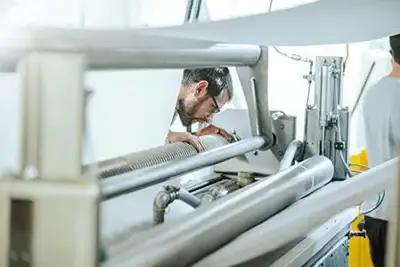
Technologies including ultrasound waves and digital printing promise to usher in a new generation of cleantech solutions for traditional wet processes.
The dyeing and finishing of fabrics has a long history of polluting waterways and using undue amounts of fresh water, chemicals and energy. Waterless solutions have been developed over the years, from supercritical carbon dioxide (scCO2) for dyeing, to plasma for applying additives to a textile substrate. But these technologies, for reasons not only related to cost but also to handling, have not been widely adopted by dyehouses and mills.
Sonovia, based in Israel, and Alchemie, in the UK, believe their innovative finishing technologies can truly change the landscape and help make a ‘dinosaur’ industry cleaner, safer and more sustainable.
‘Dinosaur’ is the term that Alan Hudd, CEO and founder of Alchemie, uses to describe the textile industry. “It can take decades to introduce a new technology in this industry,” he tells WSA. “It took ten or 15 years before digital printing became widely adopted.” He has first-hand knowledge of the industry’s resistance to that particular change, having 35 years’ experience in digital printing. Alchemie is the result of his quest to optimise digital printing, and he says that he ended up changing the whole system. Four years of research led to the development of a brand-new technology, patented in 2018, that can dye fabrics or apply finishes in near waterless conditions and with significant savings in energy and chemicals as well.
The Cambridge-based company introduced its first machine, Endeavour, last year. It offers what he says is a “large-area fabric colouration” solution and addresses a blind spot in digital printing. Widely used for high-resolution printing, the technology is considered less appropriate for applying solid colours on large areas. “The result is not homogenous,” he says.
Endeavour’s process is an evolution of inkjet printing but its printer nozzles, of which the machine has 1,440, do not come into contact with the textile. They are powered by piezoelectric crystals. When a voltage is applied, the piezo crystals change volume and this excitation process releases or “fires” droplets into the fabric. “They jet 1.2 billion drops per linear metre of fabric,” says Mr Hudd. These make it possible to dye the “whole depth of a textile, delivering the same consistency on both sides and all the way through.” Its kinship with digital printing is that it is an on-demand technology that can be turned on or off at will. This makes it possible to dye lengths of fabrics in a given colour from 100 to 2,000 metres, he says.
Piezo and infrared technologies
When printing on a polyester ground, an infrared process fixes the disperse dyes. The fabric loops through the unit to expose both sides to heat and emerges dry, requiring neither rinsing nor washing. “Infrared radiation is an efficient way of applying heat, it only heats the surface of the fabric. This system modernises an old process,” Alan Hudd says. When ‘dyeing’ cotton, the fabric goes through a steamer to fix the reactive dyes, a softener is added, and a rinsing stage is needed to remove the unreacted dyestuff.
The technology promises to radically reduce the impacts of dyeing. Contaminated wastewater is said to be reduced by 95%, energy usage by 85%, and dyes by 30%. “Dyeing is the worst process in textile manufacturing; our machine offers the apparel industry a clean technology where it is most needed,” says Mr Hudd. Compared to batch jet dyeing, which can take four hours, the Endeavour applies dyes to fabric in a continuous process, that the company says is three to four times faster. “The linear speed of dyeing is 20 metres per minute, and our machine can do short or long runs; it is very flexible.”
Alchemie is finalising another machine, Novara, which is designed to apply a functional additive to textiles using the same technology, but on a single side of a fabric. It can furthermore apply different chemistries in different zones to create body-mapped functions. “It is a modular, on-demand technology. We can selectively pattern and apply chemicals only where needed, be it water-resistance or breathability,” says Mr Hudd. Alchemie has partnered with Swiss chemicals company HeiQ and can apply all of its finishes using its printing technology. The Novara machine will be officially launched at ITMA in Milan this June.
The company says it had already sold 15 machines by the end of 2022. Taiwanese textile manufacturer JSRTEX is cited as one buyer. Mr Hudd expects to sell 50 this year and possibly 300 in 2024.
Harnessing the power of sound
As a technology said to accelerate wet processes, ultrasound, or ultrasonic processes, are used to clean textiles, as a pre- or post-treatment finish. High-frequency waves that are inaudible to the human ear are applied to a fabric after weaving to remove oil and dirt. Sonovia has upended this concept by using the same physics to add a function instead of removing contaminants. “For the past 200 years, the textile industry has used mainly one media to transfer chemicals to a textile: water. Ultrasound reduces the amount of water needed and anchors the substances deeper in the fabric,” Sonovia CEO, Igal Zeitun, tells WSA. “We are doing the opposite of traditional ultrasound processing.” The technology developed by the company is an evolution of a patent it purchased from Bar-Ilan University, which led to the creation of its SONOfix technology. The machine it uses is manufactured by Brückner, a German textile machinery maker.
The technology is not technically waterless, as the textile needs to be humid, and ultrasounds travel better through water, says Mr Zeitun. “But it saves a significant amount of water,” he insists. “In certain cases, the use of water and chemicals can be reduced by as much as 80%.” Sonovia has devised a system in which the ultrasounds, in a range of 10s of KHz, act as a propeller to drive the agent into a textile. “It propels an additive at high energy to anchor the agent deep into the fabric and achieve longer durability and higher wash-resistance,” he says.
Sonovia’s immediate focus is in the sportswear, workwear and underwear industries where it seeks to market its anti-odour application. But the company has other plans, including a technology to dye indigo into yarns to make denim fabrics. Its main solution is currently an anti-odour finish based on zinc oxide. It can be applied on any type of fabric, natural or synthetic, and their blends. The ultrasounds create a physical bond between the active agent and the fabric. “It is not a chemical bond and no binders are needed,” he says. The company claims that it can use half the amount of chemicals compared to traditional wet processing to achieve the same level of efficiency. “There is no leaching, and the finish can resist from 80 to 100 washes, it is virtually permanent,” he says. Zinc oxide has other properties: it is said to be antibacterial, antiviral, and photocatalytic. “It has the ability to destroy large odour molecules, which means it can also reduce and absorb odours that are not created by bacteria,” he says. In the future, the process will also be developed to apply a water-repellent finish.
Two prototypes of the SONOfix machine have been made: one is at Bruckner, the machine’s manufacturer, and the other at Delta Galil, a sports and underwear manufacturer based in Israel. “We began testing and optimising the process of applying our anti-odour finish at Delta Galil last July,” says Mr Zeitun. Early this year, the apparel manufacturer began testing four of its own fabrics. “We are now in true demo phase,” he says. The goal is to achieve a resistance of 100 wash cycles, which can be considered to deliver permanent anti-odour properties. The industrial partners are also seeking to speed up the process from a current rate of 15 metres per minute to an objective of 40 metres per minute. “We believe this covers 80% of finishing worldwide,” he says.
For indigo, different frequencies of sound waves will be used, and Sonovia says that, here too, it will lead to significant reductions in water use, by 70% to 80%, and a reduction in cost of between 30% and 40%. “Our process makes it possible to bring down dyeing baths from 10 to just two, cancel some of the preparation processes, and remove the need for water post-treatment. It is a true disruption in the way denim is manufactured,” says Mr Zeitun. In this case, the company does not plan to improve the durability of the dyed yarn, as this is not what the industry needs or wants. The ultrasounds, in altered frequencies, do not anchor the dye particles too deeply or too hard in the warp yarns, as the denim market wants its yarns to have a white core, considered more authentic. Sonovia is working with Italian premium denim manufacturer Pure Denim, which will be testing the process this year, and a new machine could be ready for commercialisation in 2024.
The SONOfix machine is said to be easy to integrate into existing production lines. The business model the company is pursuing is to sell the machine, install it, and then provide its proprietary formulations, or consumables. Mr Zeitun concedes that the textile industry is a challenging sector with regards to cost, performance and sustainability. “It will accept no compromise; it is a very demanding industry,” he says. Sonovia plans on developing other finishing and dyeing solutions in the future to cover all the main textile industry applications. “We have seven PhDs in chemistry, physics and chemical engineering in our multidisciplinary team, not only ultrasound specialists,” he says of the company’s 40 employees.
At Alchemie, Alan Hudd plans to sell the machine, not the chemicals: “We don’t want to create any barrier to adoption. Our machine will work with off-the-shelf dyestuffs and we intend to work with existing dyestuffs suppliers.” He adds that its process removes the need for some additives, and this is part of the company’s value proposition. This company is also working on an application for indigo dyeing.
Alchemie’s technology uses higher frequencies than ultrasound to create a resonance in the nozzle that results in the ejection of a droplet of dye or additive. Mr Hudd says that ultrasound typically uses frequencies in the range of 30,000 per second to disrupt the structure of fabric and remove contamination; his company’s technology operates at a level of 180,000 per second.
The machines made by Alchemie are more expensive than jet exhaust dyeing devices, but Mr Hudd says a single Endeavour can replace three or four jet exhaust machines, and represents a similar investment. “When you add in the savings in energy, wastewater, labour and materials, a dyehouse can achieve higher profits,” he says, adding that its machines deliver a return on investment in 18 months as opposed to several years. “Our mission is to change the image of the textile industry from the status of ‘worst offender’ to a clean tech industry. Our technology can help reshore production, and reduce shipment and logistics related to textile manufacturing.”
From its conventional use as an accelerator for various chemical and physical reactions for cleaning, emulsion or extraction, ultrasound and high frequency technologies are now, as we have seen, expanding to new fields. The next step is that a ‘dinosaur’ industry ride this new wave that can lead to significant savings in water, chemicals and energy.
Israel-based Sonovia is also working on a system to dye indigo among its plans to develop cleantech solutions for fabric finishing and dyeing.
Credit: Sonovia


