


Low-impact reused garments
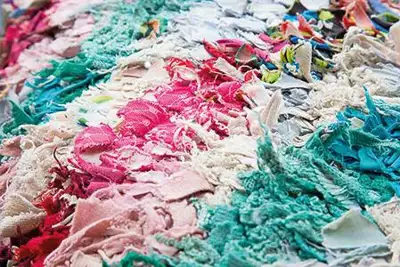
If Europe is to fulfil its vision of a sustainable and circular textiles industry, the system for collecting and sorting used garments and putting them to good use needs an overhaul.
A specialist group dedicated to textiles that the European Recycling Industries Confederation (EuRIC) set up at the end of 2019 has published a new lifecycle assessment (LCA) report. Important findings to emerge from the report include the statement that reclaiming a garment for people to wear instead of manufacturing a new one has an environmental impact that is almost 70 times lower.
The group, EuRIC Textiles, says the study confirms waste hierarchy assumptions. In that hierarchy, reuse has always been above recycling, and recycling above waste. Regrettably though, EuRIC Textiles president Mariska Boer points out that 62% of used clothing and textiles end up in household waste, meaning “valuable textiles” are likely to be incinerated or landfilled. She is the corporate communications executive for Netherlands-based textile recycling specialist Boer Group.
“The European textile reuse and recycling industry envisages a circular textile value chain where every piece of clothing is reused in an optimal way or recycled,” says Ms Boer. “This LCA study endorses the environmental benefits of a global market for textile reuse, and recycling’s potential to tackle the rising amounts of low-quality and non-reusable clothing.”
It calls on policymakers to accelerate investment in textile recycling facilities across the world. In particular, innovation in fibre-to-fibre recycling will be key in keeping fibres in the loop, the report states.
Consultants from three agencies worked on the EuRIC Textiles LCA: Norion from Denmark, Vito from Belgium and EigenDraads from the Netherlands. They analysed 16 impact categories and used a weighting method adopted by the European Commission and software to calculate a single score for different products in ‘micropoints’ (µPt), a measurement in use in LCAs, linked to estimates for the annual environmental footprint of the average consumer in the US. Knowing the score of a garment tells you what proportion of a consumer’s annual impact that single product would represent.
In the EuRIC Textiles report, a high-quality T-shirt scores 9µPt if it is reused. If it is new, its score is 628.4µPt, which is 69.8 times more. In the case of a second-grade T-shirt, the reused garment has a score of 7.9µPt, while the new one scores 549.6µPt, which is 69.5 times more. The cheapest category of T-shirt has a score of 9µPt when reused, and a new one has a score 37.4 times higher at 336.7µPt. Mariska Boer says she accepts that LCA results are often over-simplified. It is a scientific tool and, as the EuRIC Textiles experience of using it shows, involves a lot of hard work in gathering and analysing complex data. “But we want clear messages to come from it too,” she insists.
Positive waste
One clear message to emerge from this story is that reusing garments is a much better environmental option than making new ones, as the above scores suggest. In addition, the report tests the hierarchy and examines why reuse is also better than recycling. Ms Boer explains: “There is a market for second-hand clothing. Around 70% of the global population needs second-hand clothing because they don’t have the financial means to buy new clothing. For this reason, compared to plastics or metal, textiles represent a positive waste stream, one that has value and one for which there is demand.”
But there is a difference between clothing that people can and want to reuse and textile waste. Why has the whole world seen the photographs of mountains of unwanted garments dumped on beaches in Ghana and in the desert in Chile? The explanation the EuRIC Textiles president gives is that, while lots of people want second-hand clothing, it has to be clothing that meets their particular needs, including the materials the clothes are made from and how much they cost. Second-hand fashion has trends and seasons as well, she says.
This is why collecting and carefully sorting pre-worn clothing is important. “We need a refined, meticulous sorting process,” Mariska Boer continues. “And it needs to be carried out by well trained people who understand what consumers and wholesalers need. The difficult part is that what’s in demand is not always what you can supply.” If you cannot tell the difference, you end up with unsorted textile waste and, in her opinion, this is what the dumped and discarded piles of clothes in the famous photographs amount to.
To live in hope
There are well founded hopes that Europe’s 62% wastage of used textiles can improve. The European Commission’s calculation is that across the union’s current 27 member states, 5.4 million tonnes of textiles entered the market in 2019. Separately, it calculates post-consumer textile collection volumes as being between 1.7 and 2.1 million tonnes; this is what gives us the 62% figure for waste.
Improvement on this should be one of the outcomes of the Strategy for Sustainable and Circular Textiles, which the European Commission published in 2022. It quotes existing waste legislation that stipulates that member states must have in place by 2025 a separate waste collection for textiles. If we stick with the 62% waste figure, it means 38% of textiles are already being collected. By 2025, the quantity of textiles collected after consumers no longer want them is likely to increase. It seems undeniable that clothing consumption has more or less doubled since the start of the century and, driven by fast fashion, consumers are now discarding more clothing than ever.
Where fibres come from
EuRIC Textiles is pinning its hope for improvement on two things. Figures that the LCA report quotes say that of all the post-consumer textiles that collectors gather at the moment, between 50% and 75% goes back into use. Between 10% and 30% goes for recycling. However, there are reasons to fear that the extra volumes after 2025 will not necessarily boost textiles reuse and not necessarily meet the demands of consumers in the second-hand clothing market, as outlined above. The report blames a trend of falling quality and in this, too, fast fashion is in line for a share of the blame.
Of the products that are being reused, only 5% are of high enough quality to re-enter the clothing market in western Europe. Second-grade products usually go to eastern Europe and the Middle East, and lower-grade ones go to buyers in Asia. Many lighter-weight products at the more affordable end also go to Africa.
Optimism is thin on the ground that quality second-hand clothing’s 5% share of the reused textiles market can increase. EuRIC Textiles points to fast fashion as the main culprit. Churning out clothes quickly and cheaply so that consumers will snap them up and wear them for a short time means that, when those consumers move on to something else, much of the clothing coming onto the market for reuse will be cheap, with obsolescence engineered in.
In parallel, at the higher end of second-hand clothing, there is less need to collect, sort and redistribute garments and shoes because there are specialist e-commerce platforms and vintage shops in many cities that are connecting buyers and sellers of these products every day and doing very well out of it.
But there are other routes to reuse. EuRIC Textiles would like the European Commission, as part of its Strategy for Sustainable and Circular Textiles, to make it mandatory for producers of new garments to use a proportion of recycled fibres that come specifically from used textiles. In this way, clothing manufacturers will become avid users of their own waste. Mariska Boer calculates that only 1% of the fibres going into apparel production at the moment would fulfil this criterion. “That figure really needs to go up,” she says. “And we haven’t really seen the industry react yet. You see claims on the label about recycled content, but if you check, it’s not usually from textiles. It will probably take a mandatory system with a legal framework to make it happen. Once they face a mandate, companies will develop a business case for recycling.”
End of life
In a similar way, she would like the often-quoted idea that producers of finished garments should take responsibility at end of life for the products they sell to become mandatory, too. What she likes about this is the impact it would make on design. “What we’ve seen in recent years is that design has been about the look and feel of a garment, not its reusability or recyclability,” she observes. “We can see this in the rise of mixed fibres in clothes. Twenty years ago, a pair of jeans would almost certainly have been 100% cotton. Now, almost all jeans contain elastane and elastane is a show-stopper when it comes to recycling.”
Returning to the point about used garments not always being right for second-hand clothing consumers and wholesalers, complicated compositions leave sorting companies with the difficult and expensive task of arranging recycling. A coat might have wool in its outer layer, but a mix of synthetic materials in the lining, making it necessary to dismantle the whole product before you can recycle the materials. This is why there needs to be a better conversation among designers, producers and recyclers and, in Ms Boer’s opinion, a harmonised legal framework across the European Union. Even if some of the 27 member states are launching their own in-country initiatives (one came into force in Spain at the start of this year, for example), most clothing brands and retailers operate across the EU.
Hierarchy assumptions
Consultancy McKinsey has estimated that the obligation for member states to collect textile waste separately from other waste by 2025 could take volumes of collected textiles to 8.5 million tonnes or more by 2030.
In 2030, recycling these materials will still be better than discarding them, and reusing them will still be better than recycling them. In other words, the hierarchy assumptions referred to will remain valid. Of course, as Mariska Boer points out, there are steps even higher up this hierarchy. “Prevention is higher up,” she says, referring to consumers making do with the clothes they already have rather than casting them aside for something new. “And for that to be possible, re-introducing longevity and durability to the materials and garments we make is an important step, too. Long-lasting products will, naturally, be easier to keep in use, and the longer we keep them in use, the better.”
A time before
Her use of the word “re-introducing” is interesting. It suggests taking our apparel consumption back to a time before mass consumption. In contrast, it is, by definition, in the interest of multinational companies that are driven by growth and high market capitalisation to keep customers coming back to them to buy more.
“It’s a challenge,” the EuRIC Textiles president admits. “But the vision of a circular textiles industry is a good one and we will keep working to make it a reality.”
At the moment, 62% of used clothing and textiles end up in household waste and valuable materials are being incinerated or landfilled.
Credit: Boer Group


