


Another angle
The pace to meet the underserved activewear needs of more women is picking up as industry leaders begin to zoom out and piece together the bigger picture.
Outdoor brand Berghaus’ launch in mid-April of a wrap-style performance headscarf “to help remove barriers that discourage Muslim women from walking and climbing” was noteworthy for a couple of reasons. First, a hijab expressly targeted at outdoor pursuits rather than the gym, swimming or team sports, all territories that Nike, adidas, Under Armour, Lululemon, Hummel and Haute Hijab have, to varying degrees, ventured into previously, felt new. Second, the idea that the concept was first put to the company, headquartered in northeast England, by brand ambassador Zahrah Mahmood of @the_hillwalking_hijabi fame on Instagram was also significant, particularly as Ms Mahmood then went on to help Berghaus develop and refine the garment over a period of three years.
Speaking at the time of the launch, the Glasgow-based accountant, who was appointed honorary president of walking charity Ramblers Scotland back in March, pulled no punches in remarking that the scarf’s more traditional, face-framing design importantly offers practising women an alternative to the “egg head” look, her term for pull-on exercise hijabs. “The material will just stick to you and not feel good,” she says of those versions.
Points of view
To navigate this, the Berghaus team, led by senior designer Kate Ablett, landed on US functional textiles developer Polartec’s Delta fabric, introduced in 2016 as its first-ever cooling solution. Delta’s highly breathable and moisture-wicking baselayer properties made it “ideal for a technical activewear hijab”, as Ms Ablett puts it to WSA. A combination of alternating hydrophilic and hydrophobic yarns, the knitted fabric is constructed in a radiating matrix to produce an evaporative cooling effect, inspired by the body’s own natural cooling processes. Its next-to-skin hydrophilic fibres (typically lyocell, in Delta’s case, but sometimes other cellulosics) pick up and retain “little bits” of perspiration, working to regulate drying by drawing out the evaporative cooling phase in comparison to faster-drying synthetic materials. Meanwhile, knitted zones of hydrophobic fibres, mainly postconsumer polyester from recycled PET bottles, though virgin polyester is still used on occasion, stay open and breathable, as Polartec’s global director of product marketing, Karen Beattie, tells us.
All this means Delta “occupies a Goldilocks zone of comfort”, Ms Beattie explains, with a hand feel not unlike cotton, yet not as slow to dry, and resistant to wetting out and unwanted skin cling. Available in numerous weights and knit textures, Polartec Delta ranges from gossamer light and high-activity fabrications to “more substantial” versions better suited to collars, plackets and even ultraviolet protection, she adds. The lightweight variety selected by Berghaus can therefore be draped, folded and fastened to suit, without the need for multiple layers of fabric. After several rounds of testing and prototyping, the hijab is built on a cap-like base, secured by a concealed headband and fastened with a knot. Carefully placed press studs replace the unreliable, and at times uncomfortable, pins often used to fix similar scarves. The co-creators’ aim was to offer a modesty-friendly product that would help make women feel “confident, secure and ready for anything while outdoors”, according to Ms Mahmood, who Ms Ablett says was happy with the final outcome. Released only in black initially, it is currently being sold for just over $30 (£25).
“It’s weird, it’s uncommercial”
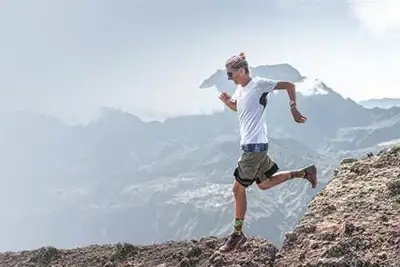
Along similar lines, another outdoor brand, Salomon, brought its 26.5-centimetre-inseam women’s Shortney shorts to market this May. In a LinkedIn post, the company’s global vice-president of apparel, Ben Ryan, described them as an “exact replica” of the pair Salomon’s Annecy design centre in the French Alps custom-makes for trail running athlete Courtney Dauwalter each season. Minnesota-born Ms Dauwalter is a two-time UltraTrail du MontBlanc champion and a Hardrock Hundred Mile Endurance Run winner, among a long list of athletic achievements. She is well-known among ultrarunning communities for favouring uncommonly loose-fitting gear, including oversized tees and knee-length, basketball-style shorts, nicknamed “Shortneys” by fans. Ms Dauwalter has said she “never imagined” she would start a trend, let alone one that would ever catch on, but acknowledges that she had “always preferred long shorts” since her early years, as they helped her feel more comfortable during training. “Comfort is key, and I know there will be many people who are thrilled to have a lightweight, long inseam option to run in,” she told Salomon.
From the brand side, more typical feedback might be “it’s weird, it’s uncommercial, there is no research to back it up and not enough people will want to buy it”, Mr Ryan went on to say. In this way, the Shortneys’ launch effectively turns conventional business wisdom on its head, he proposes, and are thus, in his view, tangible evidence of his team’s bravery, risk-taking and embrace of “the inspiration that our athletes bring us”. Made from a four-way stretch polyamide-elastane blend, using the company’s own targeted moisture wicking and quick-drying AdvancedSkin ActiveDry textile technology, the regular-fit shorts also incorporate five times faster drying 37.5 Technology for temperature regulation, reflective inserts and a semi-elasticated waist. They likewise bear a personally meaningful quote from the athlete, printed in tiny reflective typeface, just behind the right knee: “No one else can run those miles for you”. Priced at $90 (€80), they are already sold out online in either black and white or grape leaf green.
Making an impression
April further saw the launch of Unilever-owned bath and body brand Lux’s Change the Angle initiative in South Africa, to coincide with its sponsorship of the two-day Durban Open Women’s Beach Volleyball tournament midway through that month. Spearheaded by communications agency Wunderman Thompson’s Singaporean office, the campaign homes in on what it frames as media-led visual representations of sportswomen’s bodies for viewers’ consumption. “All too often, media cameras covering female athletes have zoomed in with impunity to their breasts, buttocks, thighs and crotches,” Wunderman’s global business lead, Hinoti Joshi, tells WSA. She adds that women are up to “ten times more likely than men to be objectified in sports”, citing research conducted by Californian “gender justice” organisation The Representation Project (TRP) in the wake of the 2020 Summer Olympics in Tokyo, held between July and August of 2021 owing to covid-related delays. TRP’s report, titled #RespectHerGame, says it found that 5.7% of female athletes were objectified visually (that is, “when a camera pans an athlete’s body or focuses on specific body parts in a sexualising way”), in contrast to 0.6% of their male counterparts.
Change the Angle thus set out to challenge “sexist” angles head-on, through deliberate placement of printed QR codes on the back of female volleyball players’ shorts. Scannable by a camera’s lens, viewers of certain shots are immediately directed to a short film in which athletes relay uncomfortable claims such as “2,500 images objectifying women [were] reported” during Tokyo 2020 and other statistics relating to Athens 2004. The video, viewable on YouTube and other platforms, ends with six “best practice tips” for camera operators: don’t focus on intimate body parts; frame their game, not their body; don’t create sexualised imagery; aim for athletes’ skills, not disrespectful closeups; avoid indiscreet camera angles; and capture beauty in strength and prowess. State-owned South African Broadcasting Corporation (SABC), which counts six television channels and 19 radio stations, was a key partner and, according to Ms Joshi, over 80% of media who attended the Durban Open have since shared that they would be open to adopting its core guidelines in the future. The campaign has already achieved 4.7 billion impressions and it has featured in 375-plus publications across th globe, generating $500,000 in earned media so far, she shares.
It is striking that it took Lux, a beauty brand, to cause this kind of ripple effect. The issue was raised, to some extent, at an International Textile and Apparel Association conference in Cleveland in 2018, during which two researchers from Indiana University discussed the “objectification of women in sportswear brands’ Instagram accounts”, drawing on their analysis of 1,000 promotional images or 200 each from the primary accounts of the then highest ranking sports brands in the US: Nike, adidas, Dick’s Sporting Goods, Under Armour and Puma. The team found 167 “objectifying” images of women in total, representing 33.4% of all single-person ads examined, with Nike coming off worst (39% of its Instagram visuals were considered to be “objectifying”) and Dick’s Sporting Goods faring best, at 23%. This led them to conclude that, if influenced to self objectify as a result of their media consumption, women and girls could be persuaded to abstain from sports participation, thereby hindering their athletic development.
Imaginative leap
Roughly one year prior, UK golfing etailer GolfSupport carried out its own survey of 1,700 women. Participants were asked how they really felt about athletic leisurewear and their motivations for wearing it. Strikingly, 76% of those asked reported that they “felt female activewear can be sexist at times” and 18% said they had felt objectified while wearing it. Of course, the data is not new and opinions, as ever, varied, but a couple of respondents’ comments do give cause for pause. One woman’s answer, shared on the retailer’s website, was that she believed “current trends are sexualising sportswear for women, such as sheer fabrics and panels”, which she suggested was “unnecessary and completely unrelated to what [activewear] is designed for — exercise!” Another described how tight fits, low necklines and what she felt was too much exposure around her hips, waist and chest made her feel like she “can’t run” in some sports clothing.
Fast-forward to the current year and TikTok videos tagged #GymWeirdo have been viewed in excess of 2.6 billion times as of mid-May. That number does not include #GymCreep (285.1 million views) and other spinoffs. The undertones to these videos are often voyeuristic. Men and women alike have inevitably pushed back on this social media ‘trend’ and the jury is still out. What is clear, however, is that gyms, despite their relative uniformity, are not neutral territory. How exactly sports attire plays into this debate differs from culture to culture, person to person, depending on whom you ask, and the answer is not a simple one; there are as many nuances as there are human beings.
Obviously, more formfitting or lower coverage fitness apparel does not automatically inspire “weirdo” or “creep” behaviour in others. Nor is there any suggestion here that extra layers, higher cuts or looser fits might dissuade an individual who is so inclined. But with all the investment in sportswear design, development and storytelling, there is surely room for improvement, to offer smarter solutions to more people.
Opportunities abound
By next year, the worldwide activewear market is projected to be worth approximately $575 billion, according to Allied Market Research. It is somewhat surprising, then, that concepts like knee-length, loose-fit technical running shorts for women and hijabs suitable for outdoor sporting activities still seem so novel and, in the case of Salomon and Berghaus, apparently ambassador inspired. The most hyper-visible global brands have possibly developed blind spots from the sheer scale of their operations, perhaps becoming too reliant on centralised, one-size-fits-all product strategies. Or maybe some have simply become a little too laser focused on honing top-performing products from past seasons to fully appreciate the opportunity, especially after several years of uncertainty. Either way, while women from all walks of life are still working out in generic baggy t-shirts and bottoms, dressed in all manner of less-than-technical layers to be active while remaining comfortable, why not dig a little deeper? Nothing ventured, nothing gained.
Salomon’s Service-to-Athletes design team played a major part in making Courtney Dauwalter and her fans’ Shortney dreams a reality.
CREDIT: @THE.ADVENTURE.BAKERY


