


Future-proofing the industry
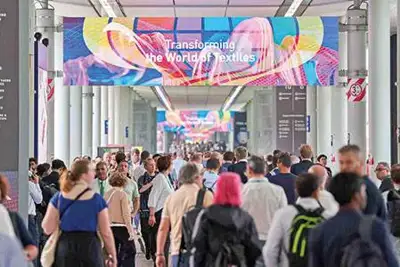
Anticipation was high before ITMA opened its doors at Fiera Milano Rho on June 8. Visitors, in numbers of over 110,000, flocked from all corners of the world of textiles and garment making, looking for faster, smarter and more efficient equipment and supplies to power next-generation materials.
Humming aisles, busy booths, lively discussions, the 1,717 exhibitors at the latest International Textile Machinery Association (ITMA) exhibition have good reason to be satisfied with this edition, the first one to take place since the pandemic. Shaping a more sustainable industry, as can be expected, was the main message put forward by the machinery, fibre and chemicals suppliers that called Milan home for a full week. Italy, not unexpectedly, topped the podium in terms of exhibitors (30%) and of visitors (29%). It was a performance due in no small part to the efforts of Alex Zucchi, president of the Association of Italian Textile Machinery Manufacturers (ACIMIT), and to the creative engineering skills of the Italian textile and fashion industry. The colours of the country’s flag, green, white and red, could be seen throughout the show’s six huge halls, across booths, machines and displays of products proudly made in Italy.
Germany came second in the exhibitor count, with 198 companies booking 15% of the total floor space, followed by Turkey, with 191 exhibitors occupying 12% of the halls. Chinese (7%) and Indian (6%) companies also made a strong showing.
Held every four years, ITMA is the place where exhibitors showcase truly innovative machinery and processes. Dyeing, considered one of the textile and apparel industry’s environmental hot spots, was the focus of much effort. Tonello, a maker of washing, dyeing and finishing equipment, featured a new lab-scale ultrasound garment dyeing machine on its booth. The use of high-frequency sound waves is emerging as a promising solution to dye yarns, fabrics, and, as seen here, even finished garments using less energy, dyestuff and chemicals. “This is an industry-first, as ultrasound has never been applied in a washing machine,” Alberto Lucchin, Tonello marketing and sustainability manager, tells WSA. The Italian company worked with Israel-based ultrasound specialist Sonovia to create the new device. “Ultrasounds have many advantages: they increase the penetration of dyes and this makes it possible to reduce chemicals and allows processing at lower temperatures,” he says, adding that it also improves the light-fastness of natural dyes, which the company offers in its Wake range.
Officina39, based in Biella, Italy, showcased Recycrom Ready To Dye, a new iteration of its pigments made from recycled textiles. The palette of 15 colours is made from a minimum of 65% pre- and post-consumer textiles, and can be used to dye cotton, wool, nylon or any cellulosic and natural fibre or blend. “Recycrom Ready To Dye is available on stock and the pigments can be mixed to create any dark or bright shade. This makes it easier for brands to adopt the concept,” says Andrea Venier. “It will also help our clients increase the recycled content of their products.”
Exhibiting in the new Start-up Valley section of the show, Colourizd, a company based in the US and Hong Kong, featured its latest warp dyeing device, the QuantumCOLOUR Denim Machine. Using the company’s ‘direct colour application method’, it is said to deliver high consistency, reduce energy use by 50% and radically cut down water consumption (by 98%), to the point of not generating wastewater. The company has seen high interest for the technology, particularly from mills based in water-stressed regions, such as Uzbekistan, whose president was part of a national delegation that made the trip to Milan.
Innovation in denim processing was a big focus of ITMA 2023, with many new products and machines, such as those on display at the booth of Yilmak. The laundry machine maker based in Istanbul has a long history of breaking new ground in the field. It invented a pumpless, and therefore energy-saving, water circulation system featured in its EcoGreen EG range. This series has now been upgraded to integrate an XDrum and XOrbs-delivering-and-harvesting technology developed by UK laundry equipment supplier Xeros.
The company has created special polymer beads designed to replace pumice stones. “XOrbs can be reused for 10 years, they last much longer than pumice, and are much safer for workers. They also reduce friction between garments which speeds up cleaning and reduces wear,” Jamie Harrison, the company’s licensing director for commercial products, tells WSA. The patented technology “fits well into our line-up”, notes Yilmak general manager for sales and marketing, Furkan Civelek, who says the company is “always looking for bright ideas”. Yilmak’s Eco-friendly 2020 HNS tumbler dryers feature another instance of smart engineering: their energy-saving closed-circuit system is designed to keep steam in circulation while fresh air is added. “Instead of needing to heat water from 0°C to 90°C, we only need to heat it from 40°C to 90°C, which basically cuts steam use by half,” says Mr Civelek.
On demand and digital
This edition of ITMA, like the one before it in Barcelona, featured a wide array of digital printing technologies. Kornit ushered in its new single-step Apollo Platform which furthers streamlined operations. An evolution of the Israel-based company’s Kornit Max printer, it is designed to simplify on-demand manufacturing, reduce inventory, and to offer a solution for nearshoring short and medium production runs, the company says.
First-time exhibitor at the show, Singapore-based NTX presented the latest version of Cooltrans. First developed for manmade cellulosic and synthetic fabrics, its ‘engineered printing’ technology can now be applied on cottons. This unlocks the possibility of printing denims, on both sides, in a single pass. “The way I describe the new Cooltrans is that it is a ridiculously precise colour-dosing technology. Extreme precision is our differentiation point,” Jeffrey Hsu, chief innovation and marketing officer, tells WSA. Application precision can go up to 3200dpi, and the on-demand, fully digital, AI-driven process is discharge-free and uses standard dyes. Among its many promises, “it can reduce minimum order quantities (MOQs) to a single piece,” he notes.
NTX is also taking an innovative approach to commercialisation. “In our business model, we don’t sell the machines, but rather partner with companies by creating a joint venture in which NTX is the majority shareholder,” says Mr Hsu. The company has already formed six such joint ventures. Mr Hsu expects two more to be signed this year. All of the jointly owned enterprises then work together, share information on processing, debugging, and can even allocate machine time to each other if needed. This is an example of a new ecosystem thinking in the textile industry, another ITMA 2023 buzzword.
Progress in recycling
Digital and on-demand processes were, along with lower-impact solutions, a key focus of an event whose motto was ‘transforming the world of textiles’. The presence of fibre producers was slightly less prominent at the exhibition. Finnish company Infinited Fiber did make an appearance. Its booth highlighted the need to build up post-consumer garment recycling facilities to address demand for cotton-like recycled fibres, estimated to be 4.5 million tonnes per year. This number is based on the volume of garments discarded in Europe and the likelihood of future legislation imposing a proportion of recycled content in products, says chief marketing manager, Tanja Karila. Infinited Fiber turns cotton-rich textile waste into Infinna fibre using a urea-based viscose production process, which is cleaner and safer than conventional viscose production, she notes. The company is currently operating a pilot facility that produces 150 tonnes of Infinna yearly, and is fully sold out, she says. A flagship factory will begin operating in 2026 at a scale of 30,000 tonnes per year. “But this would still be far from addressing future needs. If we had four large-scale factories we could produce 0.5 million tonnes yearly,” she posits, but that would still only cover a portion of demand. Ms Karila said that the company made the trip to Milan looking for partners and investors.
Textile-to-textile polyester recycling was on show at PureLoop, a division of Austrian recycling machinery maker Erema. “We are one of the few companies to have set up a working fibre-to-fibre recycling line for polyester sportswear,” Merlijn van Essen, sales manager, tells WSA. The project is featured in this issue of the magazine (see Rise To The Challenge). To make the system work as smoothly as possible, garments need to be made from pure polyester, which he says, is rare. “A garment labelled 100% polyester is never really 100% polyester, it will have tags, trimming, and assorted other non-polyester components,” he says. Blends are difficult but not impossible to recycle, he notes, mentioning a prior project involving swimwear made from a blend of nylon with a Lubrizol X4J stretch yarn with French sports retailer Decathlon. “The X4J yarn melts like polyester and polyamide, so we can obtain granules from the processing line, but these cannot be used to make fibres. They can, however, when blended with a virgin polymer, be used for injection moulding.”
Mechanical recycling solutions were prominently displayed on the booths of Andritz, from Austria, and Swiss companies Trützschler and Rieter. Demand for yarns made from recycled content is high, but achieving good yarn quality is a major challenge that Rieter believes its new Com4recycling spinning system solves. It enables customers to produce fine, high-quality ring and compact yarns from challenging raw material. This holds true even with a relatively high proportion of mechanically recycled cotton fibres, the company says. “We have focused on addressing the issue of shorter fibres that have a lot of neps after the shredding process,” Sathyanarayanan Subramanian, technology and process analytics manager for Rieter’s machines and systems business group, tells WSA. In ring spun yarns, he says that recycled content can rarely go higher than 15% to 20% of a yarn. “Our technology can now handle 50% recycled content and maintain the performances of a non-recycled ring spun yarn.” A project with Recover was featured on Rieter’s booth, which is also a topic covered in this issue of WSA (see Newcomers).
Ecosystem thinking
Collaboration was another buzzword often heard during the week-long textile industry Olympics, as ITMA dubs itself. Building a more sustainable ecosystem for textiles was one of the key messages that Valentina Superti, a director within the European Commission’s directorate for industry and SMEs, insisted upon during her visit to the show. Discussing the commission’s ‘Transition Pathway for a Textiles Ecosystem’, she says that an “ecosystem approach” has been very effective. “Collaboration across the industry and with the Commission gives added visibility to entrepreneurial and innovation projects,” she said. “We can facilitate these by helping companies find partners across the European Union and gain access to funding. We share all useful information.”
The textiles pathway document was itself a collaborative effort with European textile body Euratex. “The exchange of information is increasingly done in real time, as we have seen at the show,” says Euratex president Alberto Paccanelli, adding that, with the development of artificial intelligence, it will only be more effective. The introduction of a digital passport, he went on to say, will increase traceability and allow brands to better know their suppliers.
Lutz Walter, secretary general of the European Technology Platform for the Future of Textiles and Clothing (ETP) shares a similar point of view. “Transparency is going to become ever more important. Like the ‘know your customer’ concept in banking, it will be transposed to the textile and apparel industry, in the form of ‘know your suppliers’.” Brands will need to engage more deeply with their supply chains, much like the luxury sector does when it acquires or invests in its suppliers. “Due diligence over one’s supply chain implies relying on audits or creating true trust through long-term partnerships,” he says. Technology makes it easier to implement transparency, which will no longer be just an option or just useful to protect from greenwashing charges, and, these, he adds, will begin to be costly for brands. A fitting description of what brought the crowds to ITMA that also encapsulates what lies ahead for an industry intent on futureproofing itself.
Transforming The World Of Textiles was the motto of ITMA 2023, held at the Fiera Milano Rho. The top six countries for visitors were Italy (29%), followed by Turkey, India and Germany (6% each), France (4%) and Brazil (3%).
CREDIT: ITMA


