


Safe all year round
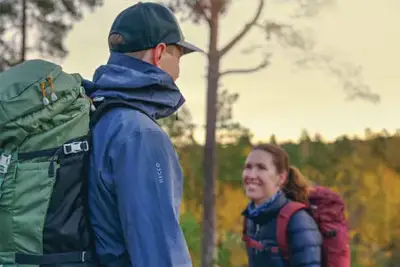
Safety system developer Recco is still snowsports-focused but is encountering increasing brand demand for its reflectors in trekking, cycling and trail-running collections too.
An ingredient brand that has a strong reputation for enhancing safety for snowsports enthusiasts is now taking large strides in year-round apparel, footwear and equipment. Stockholm-based Recco has been supplying its two-component safety technology to winter sports brands and, crucially, to search-and-rescue (SAR) teams since the 1980s. Since 2015, it has also been working with brands that want to use the technology in products for hiking, trekking, trail-running, biking and other activities that help people enjoy the mountains all year round. “This part of the business is growing more and more,” says Recco’s head of brand and marketing, Julia Granhed.
The part of the solution that goes into outdoor products is a reflector. Following application instructions from Recco, brands or their manufacturing partners incorporate these reflectors into their products as an integral component. There are several versions, in different sizes and constructions, but each “weighs nothing”, Ms Granhed says, and adds little expense.
Mirror images
These reflectors are a passive technology, she explains. They require no battery or charge. They function like a mirror. The second part of the Recco system is a detector that, following the same analogy, functions like a flashlight. Point a flashlight at a mirror and the light shines back. Point a Recco detector at one of the reflectors and it responds. This works using harmonic radar. The detector emits a radio frequency signal and the reflector sends a signal back. “It is important for us to keep working on both parts of the system,” Ms Granhed says.
Brands have been able to incorporate the reflectors into year-round products without any special considerations. The system operates in exactly the same way. The reflectors are now in jackets, running vests and other garments in collections from brands including Arc’teryx, Helly Hansen, Scott, Rab, Patagonia and Mammut. They are in footwear from Scarpa, Zamberlan, Asolo and Hoka. They are also in mountain-biking backpacks from CamelBak and in cycling helmets as well as ski helmets from safety helmet specialist POC.
In season, out of season
There are several reasons for this widening appeal. These activities are more popular than ever, Julia Granhed continues. And she makes it clear that the rescue community has also been pushing for year-long options for using Recco detectors to find people. “Less snow and shorter winters are part of this,” she explains. “Resorts are having more visitors outside the ski season and brands think that there is a growing need for safety education in these environments. Walking and running may seem easy activities, but people need to know how to prepare, how to act and how to stay safe.” A trip-plan and a charged phone are common-sense components of this. Recco reflectors can be too, plus making sure friends or family members know an intrepid trekker is Recco-equipped. The company has begun offering standalone reflectors that people can attach easily to a backpack or a helmet, but it is committed to continue working with brands and hopes more of them will integrate the unintrusive technology into gear for spring, summer, autumn and winter.
Lived experience
Extensive testing and lived experience have helped Recco and rescue organisations work out the best ways to integrate the reflectors into products and the best way to receive a signal from them when the circumstances require. For example, the positioning of the reflectors matters. An ideal place to put them in a jacket, Julia Granhed explains, is in the brim of the hood, just above eye-level, or at the nape of the neck, where there is a natural curve. Helly Hansen places reflectors in jackets and trousers that outdoor enthusiasts may wear together. In these cases, Recco’s suggestion is that the brand put the reflector near the right shoulder of the jacket but in the left leg of the trousers, or vice-versa. The explanation for this brings us to the second part of the two-component solution.
The set-up needs to make the exchange with the detector as easy as possible to make finding a stricken person as likely as possible. The recommended placements of reflectors are based on extensive testing and research, in order to guarantee optimal performance of the system.
Also, the Recco system does not work if the reflectors are under water, but the handheld detector can pick up a return signal from up to 80 metres through the air or from 30 metres through snow. Attached to a helicopter, the SAR will pick up the signal at a height of 100 metres. It is this that makes it an efficient way to search large areas for lost people in the outdoors.
Extra eyes
One of the organisations that has built up long experience of testing and deploying the technology is pioneering Swiss rescue organisation Air Zermatt. This organisation has been using helicopters to find climbers and skiers on the Matterhorn and in the surrounding area for almost 60 years. It was an early supporter of the Recco system and continues to use the technology and to work with the developer on new ideas.
There are handheld detectors now that weigh 900 grammes and are about the same size as a book, Ms Granhed says. This means members of a ski patrol and SAR team can carry the technology in a backpack. In the technology provider’s early years, its handheld detectors weighed 16 kilos. A detector that helicopter SAR crews can carry as a payload is heavier, weighing 80 kilos, to prevent it from swinging around too much.
She explains that airborne and ground-based search teams work well together, each with their own detection technology. “If you fly over a field, say, it is striking how easy it is to spot bright colours. POC has helmets in bright pink, orange or yellow and other easy-to-see colours. This is a great idea. Looking for someone wearing black or dark green is not so easy, especially if there are trees in the area.” Harmonic radar’s super-power is that it can pick out targets in high-clutter areas. SAR specialists have told Recco that the technology can serve as extra eyes for them, eyes that can see objects the human eye cannot. And if a signal does come through, it will often be faster to share the location with quick, mobile colleagues on the ground and let them reach the person in trouble.
A problem to solve
It was Julia Granhed’s father, Magnus, who founded Recco. He had lost a friend in an avalanche in Åre in the early 1970s; and took part in the search and rescue. “The rescue team had dogs, but there was no real use of any electronic tools,” the founder’s daughter says. “Transceivers existed, but their use was very limited in those days. Magnus had a Master of Science in Engineering and his two passions are skiing and technology. So, he had knowledge and a big interest in solving this particular problem.”
These days, back-country skiers and others who go off the beaten track will carry avalanche transceivers, smart phones, GPS trackers, a power bank and other tools for staying safe and searchable. Having Recco reflectors in one or more component of their kit is a complement, not a replacement, Julia Granhed insists. She sees it very clearly: “You can argue that GPS is better or that an iPhone is better, but why compare? Why choose? All tools are good, but you never know if one will run out of battery or where and when the signal may disappear. If you also add a Recco reflector, you optimise your chances.”
Fresh from a discussion she took part in with cycling, ski and running brand Scott at the 2026 Ultra Trail of Mont Blanc event in Chamonix at the end of August, she says Recco reflectors are not about adding performance to a product. Instead, they add to safety. “This is like insurance,” she explains. “It is something you hope you will never need to use, but you know you should have it just in case.”
She argues that what Recco offers can also help brands by giving them something important to include in their dialogue with consumers. She also thinks acting as a bridge between outdoor brands and the SAR community is an important service, one that could help save time and money when an incident occurs, one that can make the search process safer for rescuers, one that can save lives.
A hiking jacket with a Recco reflector in the sleeve. If wearers encounter difficulty, a search and rescue team will be able to use a Recco detector to find them in the forest or in the mountains. Credit: Recco


