









Healthier competition
Outdoor sports group Goldwin has been running its own race for over 70 years. It is now working closely with an array of partners, including AI technology provider Synflux, to keep pace with new, low-waste technologies and stay ahead of the sustainability curve.
Bound up with multiple culturally specific connotations, any literal translation of the Japanese concept of monozukuri presents a challenge. For the directors of Tokyo-listed sporting goods manufacturer Goldwin, chairman Akio Nishida and president Takao Watanabe, however, the idea is more of a state of mind, driving the company forward in pursuit of new levels of innovation and continual improvement. It permeates the design, function– ality and aesthetics of every Goldwin-made product, Mr Watanabe says, and serves as a core guiding principle, meant to focus stakeholders’ attention on what it calls the “true value in the invisible”. The monozukuri spirit is, thus, understood to inspire an attitude of care and sensitivity towards otherwise unseen production details and techniques.
This philosophy also ties in neatly with a key component of the Goldwin group’s strategic vision, which is to support the natural environment “through unbound[ed] imagination” that leads to pioneering breakthroughs for the betterment of the world and its ecosystems. The business became an official partner of National Parks Japan in October 2020, for instance, after agreeing a deal with the country’s environment ministry. Part of this role involves a commitment to promoting the use, enjoyment and protection of 34 national parks by way of co-branded communications and limited-edition ‘sustainable’ lines produced alongside outdoor performance labels like The North Face (TNF) and Helly Hansen, the local licences for which Goldwin has held since 1978 and 1983, respectively.
It later acquired the Japanese trademark rights for TNF in 1994, followed by Helly Hansen in 2017. More recently, the company launched its multi-brand resale initiative Green Baton last July. This take-back project includes repair and refurbishment of used TNF or Helly Hansen articles, beginning with childrenswear, in exchange for store coupons. Where donations are found to be in irreparably poor condition, Goldwin will endeavour to recover as much reusable material as possible for upcycling. The resulting products will be resold with the Green Baton logo.
Running well
Goldwin is primarily a performance wear manufacturer. Founded by former textile mill employee Tosaku Nishida in 1950, the group started life as a producer of knitted fabrics out of a 130-square-metre factory in Oyabe, Toyama prefecture, some 380km west of Tokyo before quickly moving to concentrate its efforts on sportswear by 1952. Mr Nishida had rather astutely predicted that customer demand would blossom post-war. Own-brand athletic gear came next in 1958 and, in a direct nod to Olympic “gold winners” and its owner’s ambitions, the enterprise previously known as Tsuzawa Knit Fabric officially became Goldwin in 1963. The outfit would indeed go on to clothe 80% of Japanese gold medallists at the 1964 Summer Olympics in Tokyo, but not before Mr Nishida had spent a month travelling around Europe ahead of the Innsbruck Winter Olympics earlier that same year to dissect the technologies of competing textile firms in Italy, Germany, France, Switzerland, Norway, Denmark and the UK. Although he passed away in 2012, Goldwin has shown itself capable of continuing its founder’s legacy by continuing to push forward into new territories ripe for innovation.
Aside from TNF and Helly Hansen, the group’s domestic business comprises sports companies such as Ellesse, Danskin, Icebreaker, Speedo, Neutralworks, Woolrich, Macpac, Canterbury, And Per Se, Maxifresh Plus (MXP) and Fischer at present, not to mention Goldwin Motorcycle and high-end flagship ski and outdoor brand Goldwin. It does not disclose individual financial data, but TNF is widely considered to be a top seller. According to a summary of results for the nine months ended December 31, 2022, released by Goldwin in early February, net sales across the board rose by 17.6% year on year to roughly $660 million or ¥86.7 billion, whereas total operating profits reached just under $140 million (¥18.3 billion), representing an increase of 29.1% versus the year previous and a new record for the group. The firm subsequently raised its full-year net sales forecast to approximately $865 million (¥113.5 billion), an adjustment of 7.2%. Local media reports singled out stronger than expected sell-through of higher priced cold-weather apparel, mainly TNF down jackets and fleeces, as a major contributor to this growth. The deliberately niche TNF Purple Label, meanwhile, a joint venture with Tokyo-based functional fashion brand Nanamica, is thought to make up no more than 5% of TNF Japan revenues. (Nanamica is the brainchild of long-time Goldwin creative collaborator Eiichiro Homma, who became the label’s founding designer in 2003.)
The red thread that harmonises the company’s various brands and sub-brands today could be said to run against the grain of profit over improvement. Mr Watanabe told reporters last year that Goldwin’s targets for 2030 include taking the proportion of “environmentally friendly” materials present in its ranges from 28% to 90%, in addition to reducing the amount of textile waste it generates to zero. Already, the firm has made real strides, at least in the latter area. Applying a proprietary artificial intelligence (AI) system called Algorithmic Couture from Keio University spin-off Synflux to both a TNF softshell jacket pattern and a matching fleece sweater-and-joggers set from Neutralworks, each offered in two colourways, has so far led to as much as two-thirds less cutting waste than would typically be produced using standard sewing patterns, the partners estimate. Synflux was officially founded after its algorithmic design approach was selected by H&M Foundation as its ‘early bird’ winner of the 2019 Global Change Award innovation challenge.
Illustrating Goldwin’s own faith in Synflux technologies, its decade-long $23 million (¥3 billion) Goldwin Play Earth Fund, established together with corporate venture capital arm Goldwin Venture Partners only last year, participated in the start-up’s latest financing round back in December, which raised $1.6 million (¥210 million) in all. The goal of the fund is to accelerate sustainably minded solutions for the activewear market. It is jointly managed by Ignition Point Japan.
Leaning out
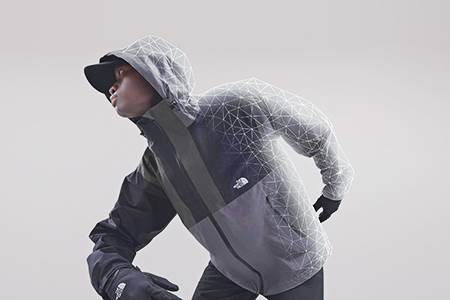
The first fruits to come from the group’s tie-up with Synflux, promoted under the project name Syn-Grid, landed in TNF’s The North Face Lab and The North Face+ stores, respectively located in Tokyo’s Shibuya ward and in the Kita ward of Osaka city, at the start of last November. The jacket features Gore-Tex’s 20-denier, three-layer micro grid backer technology, which allows an expanded polytetrafluoroethylene (ePTFE) membrane to bond with 100% nylon fabric. Neutralworks’ leisurewear set, on the other hand, is made from bonded sherpa fleece, 70% of which is recycled polyester. The rest of the fabric is composed of virgin polyester fibres. Launched the very same day via the latter brand’s Ebisu boutique in Shibuya, the sweater and trousers were also made available through the brand’s online shop.
Synflux co-founder and design director, Kotaro Sano, tells WSA that these initial retail-ready garments were two years in the making. Mr Sano had met a TNF Japan executive at a talk and the team began collaborating with the specialist Goldwin Tech Lab manufacturing team not long after. Building on Goldwin’s own advanced sewing and patternmaking techniques, Algorithmic Couture was able to reduce the cloth waste rate to 5%, he says, without compromising comfort or performance. It did so by using three-dimensional computer-aided design (3D CAD) software to minimise the gaps between nesting seams, the design director explains, inspired by rectangular-shaped Japanese kimono patterns, as opposed to curve pattern-cutting on square fabrics. He suggests the latter can lead to as much as 30% of fabric being wasted during production, as patterns are designed to fit a length of fabric, rather than the curves of the human body.
Algorithmic Couture works by importing partners’ current 3D product patterns and then applying machine learning algorithms to reconfigure them geometrically using simulation. Though the tool remaps patterns on a matrix of squares and triangles, no changes are made to the original fit or silhouette. As the technology is based on fabric pattern and marking systems prevalent throughout the fashion industry, it can “easily” fit into existing manufacturing set-ups, Mr Sano states. Working with Goldwin has proven that Synflux AI works well at commercial scale, he adds, as the group typically makes anywhere between 10,000 and 100,000 units of each style. The group’s in-house expertise has even helped the start-up hone its algorithms.
Next-level successes
A particularly unexpected outcome of the Syn-Grid development process, its co-founder shares, was the creation of a new set of algorithmic design tools able to “dramatically improve athletic performance”. This latest system analyses motion data to automatically generate new clothing patterns made to foster more comfortable movement by minimising the stress on fabric construction and, therefore, unnecessary performance-limiting strains on the body during exercise. Synflux has observed strong interest in Syn-Grid since its November debut, Mr Sano tells us, especially from younger consumers and eco-conscious investors as well as the work with Goldwin and others on waste-reducing, lower impact production remains ongoing.
Goldwin, a little less forthcoming, perhaps due to the degree to which it privileges ‘invisibility’ when it comes to product and process refinement, will surely be encouraged by the progress it has already made in the zero-waste design field in advance of its 2030 targets. As indicated by the remarks of a company spokesperson at the time of Syn-Grid’s launch last year, the group is only too aware that simply designing in more sustainable fibres, dyestuffs and other materials will certainly not move mountains in the ever-more-important realms of overconsumption and overproduction. Getting to the root of textile waste means digging deeper.
Algorithmic Couture's deep roots in traditionally flat-cut kimono patterns adds yet another "invisible" layer to the two companies' ongoing partnership
ALL CREDITS: Goldwin



