






New legacy thinking
The first technical outdoor gear to be produced with a non-fluorinated Gore-Tex membrane landed in stores towards the end of 2022. Over a decade in the making, many of the industry’s biggest names have recognised this material as a potential game-changer and welcomed it with open arms.
Last autumn, an impressive line-up of global sports and outdoor brands brought a promising new technology from WL Gore’s fabrics division to market for the very first time. The innovation, made from expanded polyethylene (ePE), was billed as a complementary, more environmentally friendly materials platform for Gore-Tex membranes at its first introduction to the press in 2021. It has now debuted in functional apparel, accessories and footwear designed by major industry players such as Patagonia, Reusch, adidas Terrex, Salomon, Arc’teryx, Dakine, BlackYak, Ziener, K2, Hestra, Zanier, Kolon Sport, Eider and Roeckl. Shoe brands Meindl and Camper will be next to launch styles with the membrane material this spring-summer, Gore’s consumer fabrics business leader, Achim Loeffler, tells WSA.
The company has been engaged in this project since 2009. Completely free of perfluorochemicals (PFCs), ePE’s addition moves the business further along on its “responsible performance journey”, a key aim of which is to phase out what it considers to be PFCs of environmental concern (PFCECs) over the entire lifecycle of its consumer products. Gore identifies highly fluorinated, persistent PFCs that are small enough to be bioavailable, for example in the water supply, as PFCECs. Originally, the plan was to have eliminated PFCECs by this year. Despite ePE’s ability to replace several PFCECs in the Gore-Tex range, the team does not now expect to meet its target before 2025. Mr Loeffler attributes the delay to “product development and scaling challenges”. (The insolubility and non-biodegradable qualities of expanded polytetrafluoroethylene [ePTFE], the fluoropolymer on which Gore-Tex built its reputation, are among various properties cited as reasons for what Gore calls ePTFE’s environmental soundness and safety.)
Warming up
In ePE, Gore’s textile technologists have access to a lower mass, yet high-strength material with which to construct membranes of roughly half the average thickness of others in the portfolio. The expansion process gives it microporous characteristics by creating “billions” of tiny holes that allow vapour to pass through. Combining ePE with polyurethane produces a breathable, windproof and durably waterproof membrane, the company argues, with internal field tests finding ePE apparel laminates, for general outdoor and everyday use, to be both “very breathable” per Hohenstein’s comfort rating system and as durably waterproof as Gore-Tex ePTFE laminates.
Footwear for daily usage proved just as durably waterproof and breathable with an ePE laminate as comparable designs made with ePTFE. Gloves for snow sports, to which ePE is added as an insert, likewise offered the same level of breathability and durable waterproofing with ePE as they would with an ePTFE insert, Mr Loeffler confirms. Company calculations based on Higg Materials Sustainability Index criteria suggest that articles containing a Gore-Tex ePE membrane could have a lower carbon footprint overall, owing to the composite’s high strength-to-weight ratio, which results in a reduced mass, plus the potential for products to have a long useful life, owing to its hard-wearing resistance to the elements.
Winter sports glovemaker Reusch, a Gore-Tex partner of multiple decades, received its first samples of the new fabric technology in 2020. “We have been challenging each other for years,” the brand’s marketing project manager, Ilaria Pellegrini, says of the relationship, which she describes as one of mutual trust and support, particularly in the realm of product development. Reusch found the technology to be “way more flexible and breathable” than other Gore membranes it had tried, Ms Pellegrini notes, resulting in a more comfortable pair of gloves, but the company was also attracted to the material’s improved sustainability credentials, an important value-adding feature that she explains has been especially welcomed by the retailers it works with. The brand launched its first gloves with a Gore-Tex ePE membrane sandwiched between shell and lining seams in the final months of last year.
Sold under the name Discovery Gore-Tex Touch-Tec, the design is primarily targeted at freeriding skiers and snowboarders. The gloves are made from a water-repellent, four-way stretch softshell polyester and goatskin, with a wool blend lining, and incorporate Reusch’s own, patent-pending Heat Capture system, based on a gaiter construction inside each cuff. The team found the membrane to perform best when coupled with already water-repellent fabrics, Ms Pellegrini goes on to say, but they are “very satisfied” with its quality and functionality. So far, customer feedback has been positive. Beginning next autumn-winter, all new Reusch models requiring a Gore-Tex insert will be manufactured with the ePE membrane as standard, representing around 13% of its lines. Over time, the brand will gradually transition existing Gore-Tex glove styles over to ePE too, the company states, and by next winter the number developed with an ePE membrane is expected to reach eight. “Since most of our business depends on our winter collections, featuring a reliable waterproof membrane is paramount if we want to stay true to our quality promises,” she concludes.
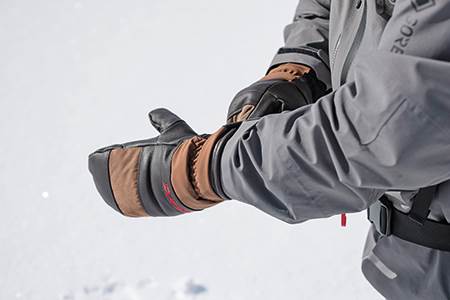
Interestingly, outdoor and winter sports label Dakine similarly chose to debut Gore ePE in snow sports gloves before any other category. The company was introduced to the material in late 2021, category director for performance at Dakine licensee and sports equipment producer JR286, Wallace Mills, tells us. Mr Mills says the main pull towards switching to an ePE membrane for the brand’s Baron Gore-Tex Index mitt was the promise of eliminating harmful PFCs, but he adds that the membrane is equal in performance to the insert Dakine used previously. Not unlike Reusch’s Discovery Gore-Tex Touch-Tec gloves, the Baron mitt is majority goatskin, with a four-way stretch polyester shell and a wool lining. It additionally boasts Gore’s Grip technology to prevent the insert from moving inside the glove, plus synthetic PrimaLoft insulation. By autumn-winter 2025, all Dakine snow gloves will rely exclusively on Gore ePE in the membrane. This, combined with continued use of a C-Zero water-repellent finish, will mean the total removal of PFCs from the range, according to Mr Mills.
Raising the game
Other significant ePE applications in recent months include Patagonia’s Storm Shift jacket, which won an ISPO Award in the autumn for its double-layer Gore-Tex ePE laminate and 100% recycled polyester shell, among several jury-pleasing technical details. Earlier, Gore launch partner adidas Terrex was also nominated for one of the prizes for its new Xploric Parley Gore-Tex suit. The two-layer material used for the jacket and trouser set, whose separate elements fasten together with a zipper, is made entirely from recycled polyester, obtained from marine waste by long-time adidas partner Parley for the Oceans. Terrex exhibited the suit during the fifth China International Import Expo in Shanghai last November. Another glovemaker, Ziener, unveiled ski gloves and mittens around the same time. Both its Gastilo mitten and Keala glove model feature leather palms and a 50% viscose and 50% recycled polyester fibre body, as well as Goldeck’s synthetic G-Loft insulation. Arc’teryx included the material in its Ralle and Coelle jackets, while fellow outdoor company BlackYak released 343 D Eco GTX, a new hiking shoe which notably contains recycled content within the laminate.
Integrating recycled textile material in ePE membranes is already a reality for Gore, in line with the firm’s “sustainable performance” ambitions. A small number of laminates in partners’ current season collections were certified to Global Recycled Standard (GRS), Mr Loeffler reveals, but there is strong forward momentum in this area: 82% of clothing made with Gore’s ePE laminates next autumn-winter will be GRS-verified. All will have been at least partially produced using recycled textile components. Regarding shoes, eight ePE footwear laminates will carry a GRS label. The manufacturer achieved full GRS certification for both its Shenzhen and Putzbrunn fabrics plants last year, with plans to undergo Scope certification at its Maryland site during fiscal 2025. Importantly, its ePE laminates not only bond well with select recycled face and backer fabrics, but also certain undyed or solution-dyed materials. The consumer-facing portfolio is expected to have obtained bluesign approval by next winter.
Mr Loeffler explains that Gore means to be “very strategic” about how it scales ePE in the months and years ahead. He points to the business’ track record of honed ePTFE and its uses over many years and suggests that ePE’s potential will grow alongside developers’ efforts to push past conventional comfort, performance and sustainability boundaries.
Identifying and aligning with partners on a similar journey is clearly a top priority to this end. Patagonia has already pledged to be first to market with a number of even newer GRS-certified Gore-Tex laminates that combine ePE with recycled polyester, for instance. Yarn manufacturer Bionic will supply polyester fibres solely derived from discarded plastics sourced from collectors in Costa Rican coastal and municipal communities. Perhaps most strikingly, though, Gore has announced plans to invest in a local plastic recovery and sorting facility that Bionic is setting up in the Central American country, presumably to help secure a ready stream of feedstock.
Snow sports gloves have proven popular destinations for the new ePE membrane, incorporated as an insert.
Credit: Dakine







