







Garment design in the age of circularity
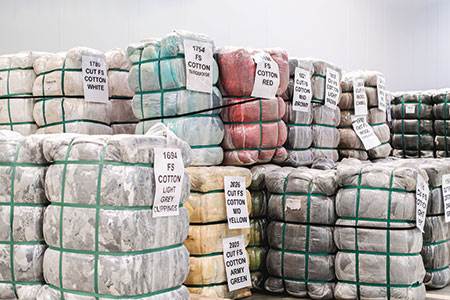
At each stage of a future circular apparel ecosystem, the design of an item of clothing will impact how smoothly the process runs. The sorting of used textiles is one of the more complex stages. Current systems are designed to pick out the highest value garments for resale. Much of what remains, which could be recycled into new fibres, will go through a different type of sorting, by colour and composition.
A key step in building up the recycling capacity of waste textiles, which remains acutely low at less than 1%, is to ‘produce’ homogenous secondary materials that are suitable for recycling. At the current stage of development, mechanical recyclers will want, say, 100% cotton in a format that preserves fibre length. Companies that recycle cotton into pulp for manmade cellulosic fibres will request waste with high cotton content, but will not be concerned by fibre quality. Thermomechanical and chemical processes need feedstock that is nearly pure polyester, cut into small pieces, sometimes compounded into ‘popcorn’. Few recycling technologies can take in mixed waste; Worn Again and Ravel are exceptions. But ‘mixed’ is the reality of a high volume of discarded clothing and textiles, and solutions for this reality are definitely needed.
Comprehending the real-world conditions of used clothing is as simple as taking a look in any clothing closet. What does it contain? A woollen suit, cotton-polyester trousers, a viscose blouse, jeans. The sweaters and baselayers can be made from a variety of fibres, wool alone, or blended with cashmere, acrylic, polyester, even cotton. They can at times be made from three or more fibres. This has never been flagged as a problem. In fact, it is often a selling point: cashmere enhances the value of wool and, when blended with polyester, the item will have a lower price-tag.
When no longer worn or wanted, these items of clothing will probably be dropped into collection bins. This is when the process of sorting and grading begins where each one will be directed to a preferred new use: resale or recycling. And this is one of the main bottlenecks in the titanic task of turning textile waste into a resource.
Collectors and graders, who are experts in sorting, now face a critical situation that has stripped them of the financial resources that made their business viable. Significant portions of what they call ‘crème’, clothing that can be resold at high value, never make it to their facilities as consumers pocket the money by selling their unwanted garments online, using apps such as Vinted. The rise of fast and ultra-fast fashion, often quickly binned, has also put a dent in their revenues.
Automated sorting devices are seen as a way to speed up sorting and reduce its cost. But the equipment itself is costly, and a return on investment uncertain, as an industrial recycling infrastructure is slow to come out of ground. It is nonetheless imperative that discarded clothes, shoes and home linens avoid landfill or incineration.
The two approaches, sorting for reselling or for recycling, follow different sets of rules. For resale, a three-fibre blend jumper, if it is still stylish and in good condition, will not be a problem. For recycling, it could, on the contrary, be considered a source of contamination.
Sorting twice
The collecting and sorting industry has always been a self-supporting industry, Mariska Boer tells Sportstextiles. “It uses revenues generated by the sale of second-hand clothes to support the processes needed to recycle the non-reusable products,” says the co-owner of Boer Group, a Dutch used clothing collector, who also heads the Textile division of the European Recycling Industries Confederation (EuRIC). The evolution of fast fashion and online resale platforms has undermined its business model. Boer operates seven sorting plants in Germany, Belgium, France and the Netherlands and produces mechanically recycled nonwovens.
Glass, metal and plastics, she says, have a market value as waste and are therefore bought by recyclers. “This system does not apply to textiles as, historically, the value of the second-hand garment market paid for the non-reusable items.” Due to the lesser value of used apparel that is collected, EuRIC is calling for a systemic change in how the sector operates.
Sorting for recycling is a whole new world for today’s collectors, says Ms Boer. Her company has recently acquired an automated system for sorting by fibre composition. The system is Fibersort, developed by Belgian company Valvan; it includes dismantling operations. Mariska Boer says that this should increase the amount of fibre that can be recycled into new yarns for garments, but she questions who should be making these million-euro investments. Should it be municipalities, or could extended producer responsibility (EPR) measures shift the onus to brands and retailers?
“There is a missing link between what is designed and put on the market and what can be recycled when it reaches end of life,” she points out, and this requires collective action. “Designers are asked to create products that will sell, not products that are sustainable or recyclable.” It has not been the role of designers to look to avoid what recyclers call ‘showstoppers’: details or ornaments that prevent a product from being recycled.
Missing links
“We’ve spent years reverse-engineering how textiles are made to develop recycling technologies, whereas the industry should be asking itself whether clothing could be designed differently,” agrees Cyndi Rhoades, co-founder of Worn Again and more recently co-founder and CEO of Circle-8 Textile Ecosystems. Circle-8 has ambitious plans to build three 50,000-tonne automated sorting facilities in the UK. Ms Rhoades says there are enough discarded non-rewearable clothes in the country to justify 15 such facilities. “We need automated sorting facilities to avoid sending non-rewearable clothing to landfill or incineration.” Initially, she expects the demand for feedstock from chemical recyclers to be limited, given the current stage of their development. “We will start by supplying existing markets with non-reusable textile inputs for making second-use products, such as insulation, as emerging fibre-to-fibre recyclers scale up.”
A first facility, whose location has already been chosen, should be operational by the end of next year, depending on market conditions. These facilities will only be financed if the key drivers of materials circularity, namely brands and retailers, show clear market demand for recycled content. Circle-8 has purchased a single-line automated sorting machine made by Danish company NewRetex, which is due to be delivered next March, she tells Sportstextiles. It can identify the composition and colour of one garment per second, but instead of compressed air, it uses gravity to dispatch each item to a specific bin. “This makes it relatively quiet and reduces energy consumption,” she says.
In addition to identifying colour and composition, the device scans items using X-rays, enabling it to ‘see’ inside pockets. It also weighs and measures each item, information that will feed a database, enhance traceability and the monitoring of non-reusable, post consumer products. “As these types of facilities are scaled, we will see patterns emerge which will help further designing for circularity in terms of phasing out complicated blends which can’t be recycled," Ms Rhoades points out. The data collected could also help brands better understand what happens to their goods once discarded. Ms Rhoades suggests that further transparency around what’s in the wider pool of post consumer textiles would allow brands to better understand their responsibilities in furthering or hampering a circular ecosystem for apparel. “We’d like to see the post-use textiles supply chain work together on scaled sorting solutions to support cost efficiencies, quality of feedstock and methods for transparency,” she says. She believes no one player can solve this problem on its own for the industry. Collaboration to find joined-up solutions will make it easier to follow the flow of used clothing and the materials they are made from.
In the meantime, Ms Rhoades says that all options need to be kept open, including downcycling solutions. “We need to be realistic. Chemical recycling will happen, but not as soon as expected. At present, only a portion of post-consumer non-reusable textiles are recyclable.”
Each recycling technology has different requirements for the waste that it can take in. Often, it will need to be pre-processed and prepared to each recycler’s specifications. This adds another layer of complexity to textile waste management, as Tim Cross, founder and CEO of Project Re:Claim, points out. “Sorting facilities will need to address different customer requests and may only be able to meet 60% or 70% of demand.” He believes that artificial intelligence will make automated sorting more efficient and that digital product passports will also help boost output, but both of these may be years away.
Project Re:Claim, a thermomechanical recycling facility installed in a Salvation Army site in the UK, has been running for over a year, acquiring on-the-ground experience of handling textile and clothing waste. “Our production line is designed for post-consumer clothing,” says Mr Cross. “But we need garments designed for recycling, and until these are in sufficient quantities, we rely on post-industrial waste.” He is addressing this issue through the Circular Textiles Foundation, which he also founded.
The foundation trains designers, assists brands in developing circular products and provides a certification label indicating that an item of clothing is fully recyclable, as is. It has devised a simple formula to educate the industry: a theory of thirds. Mr Cross says that one-third of clothing on the market is already recyclable, but brands are unaware of this. One-third could be made readily recyclable with a few minor changes that would not affect a garment’s aspect or performance, he insists. One such solution is using sewing threads that are of the same composition as the item of clothing, be it cotton, nylon or polyester. And, finally, one-third will require either a massive redesign or a new recycling technology. “It is a revolution in thought. It does not require a new breed of designers. We can get there quickly,” he says.
“It’s taken a good five or 10 years for the industry to get up to speed on the differences between the variety of mechanical and chemical recycling processes. Now we’re asking companies to learn about automated sorting and pre-processing,” notes Cyndi Rhoades. This is where brands and designers may see their roles change. “EPR policies are the stick for engaging brands, but we also need a carrot. Once large-scale sorting and recycling facilities are up and running, we aim to offer brands and retailers preferential access to textile-to-textile recycled fibres, via recycling partners.”
Brightfiber Textiles officially opened its recycling facility in Amsterdam this spring, following the acquisition of Wieland Textiles, a Dutch collector that helped Valvan fine-tune the Fibersort.
Credit: Brightfiber Textiles



