







Circular connections
A partnership between Hyosung and Loop Industries could help the industry move beyond bottles to a circular polyester solution.
Korean textile conglomerate Hyosung and Canada-based recycling tech company Loop Industries have joined forces to bring textile-to-textile recycled polyester to market. The construction of a first industrial facility for the blend-tolerant and low-impact technology developed by Loop represents a big step in shifting from fossil- or bottle-derived polyester to a circular solution.
“We have made great progress with Loop Industries,” says Simon Whitmarsh-Knight, Hyosung’s sustainability lead, of a partnership that began several years ago. He was speaking at a conference at Première Vision alongside Adel Essaddam, Loop Industries chief operating officer and co-inventor of the company’s recycling technology. Hyosung is already incorporating virgin-grade 100% textile-to-textile recycled pellets made by Loop into its regen-branded polyester yarns. The two partners expect to expand their collaboration when a first large-scale facility begins production in India in 2028.
Loop’s patented recycling technology is said to be able to recycle low- and no-value PET and polyester waste. This includes textile waste as well as PET trays, carpets, and even ocean plastics that have been degraded by exposure to sun and salt. This is a step up from mechanical, thermo- mechanical or chemical recycling technologies that require mostly ‘pure’ polyester waste. At its Terrebonne facility in Québec, Mr Essaddam says the company has trialled more than 2,500 different types of feedstock from varied sources, including blended textiles and opaque plastics.
Another advantage of the technology is that it operates at low temperatures (below 90°C) and without added pressure. This makes it a low-cost solution for a commodity material such as PET, says Mr Essaddam. He points out that “the depolymerisation of PET was invented at the same time as the polymerisation process itself”. But “the challenge at the time was that depolymerisation required high temperatures and high pressure to break the chemical bonds”. The low-temperature and low-pressure recycling conditions of Loop’s technology is a “unique feature that gives it a higher yield and a lower footprint,” he says. A lifecycle analysis (LCA) study found that the process emits 80% less CO2-equivalent than fossil fuel pellets. “The LCA only covers the production process; it doesn’t even take into account the fact that we use waste as a resource,” he notes.
A unique technology
“Textiles pose a singular issue,” says Mr Essaddam, “because polyester is dyed and often blended with other fibres.” Loop’s recycling process removes unwanted substances, dyes and fibres, including cotton, spandex and nylon. “Since our technology depolymerises PET and polyester at low temperatures with no added pressure, all non-PET content is left untouched. This means that we can take waste that other recyclers cannot accept,” he says.
For the process to be economically viable and to avoid having significant amounts of waste to manage, Loop has set the bar for its feedstock specifications at 85% minimum polyester content. “Textiles are often blended, and for good reason,” says Mr Essaddam. “An item made from a 100% polyester fabric won’t offer consumers the performance they expect. Garments need to offer functionality, and this is why we need a recycling technology that can process blended textiles.”
Loop’s technology takes polyester back to dimethyl terephthalate (DMT) and monoethylene glycol (MEG) monomers, rather than purified terephthalic acid (PTA) and MEG, which are the more common building blocks. “This is a deliberate choice,” says Mr Essaddam “as it avoids the complications of purifying PTA.” DMT is distilled back to virgin-quality, with all unwanted substances filtered out. “Even black fabrics can be made into white curtaining,” he says.
Scaling production
Over the past few years, Loop formed various partnerships to set up large-scale PET recycling facilities. Two such projects were announced in 2023, with Suez Group in France, and SK Geo Centric in both France and Korea, but have since been abandoned. “Capital expenditure was too high,” notes Mr Essaddam. A newer project, in India, with local polyester producer Ester Industries, requires a lower initial investment. “We decided to pivot to a joint-venture with Ester, in India, where building expenses are cheaper,” he says.
The projected facility will have a capacity of 70,000 tonnes annually and is estimated to cost approximately $176 million. The chosen site, in Gujarat, is in an officially designated Petroleum, Chemicals and Petrochemicals Investment Region (PCPIR), a status that helps expedite permits. The location has other advantages as it will provide the joint-venture with access to post-industrial and post-consumer polyester textile waste from nearby Surat, said to be India’s synthetic textile capital. The region also has a skilled labour force and is close to a deep-water seaport at Kandla.
This facility will then serve as the blueprint for future Loop factories, with one planned for Europe. Late last year, the company sold its first technology licence to investment group Reed Societé Générale. A new entity was established, Loop Europe, 90% owned by the bank’s investment arm and 10% by Loop. The licensing agreement has generated an initial payment of €10 million, to be followed by additional milestone-based payments from Reed Societé Générale.
Market testing Twist
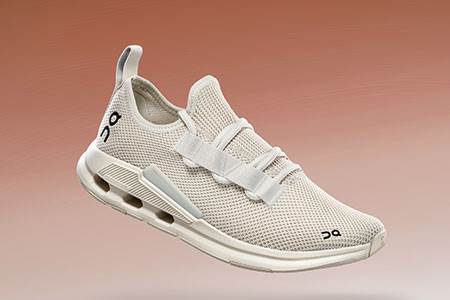
With these industrial projects firmly on the horizon, Loop has been supplying its textile-derived recycled polyester to a number of innovative companies. In 2022, Swiss activewear brand On chose the yarn for the uppers of its Cyclon running and lifestyle shoes. It will also take back these products when no longer used. Loop introduced the brand name Twist for its 100% textile-to-textile polyester this summer. In an SEC filing from September, the Nasdaq-listed company also announced that it had signed “a multi-year off-take agreement” with “affiliates of a leading sports apparel company”, once the Infinite Loop India facility becomes operational.
With Hyosung, a range of limited-edition bags by Korean brand Pleatsmama was released earlier this year. Loop supplied the Twist pellets to the Korean fibre producer, which has invested in the Pleatsmama brand. “Building on the success of this collaboration, we are proud to deepen our strategic alliance with Loop Industries and address growing demand for T2T (textile-to-textile) polyester,” says Mr Whitmarsh-Knight. “Circularity is an industry-wide challenge that requires close collaboration.”
Both partners agree that large-scale uptake of fibre-to-fibre recycled polyester could be boosted by regulations. “Extended Producer Responsibility (EPR) measures have been activated in the European Union, and this is essential for the creation of a working ecosystem for textiles recycling,” says Mr Essaddam. Mandatory minimum recycled content in apparel would increase demand for recycled polyester, as it has in PET plastics. The example set by France’s EPR system is very generous, he adds, as it compensates brands for every percentage point of recycled content they incorporate into their products. Mr Whitmarsh-Knight is of the same mind: “Mandatory recycled content is the magic wand needed to unlock demand. Ideally, we need a global EPR system. We’ve seen it work in packaging; now we want to see it applied to textiles.”
As the partnership with Loop Industries readies for commercial scale, Hyosung, the world’s largest elastane producer, is also working with several industrial partners to recycle its Creora stretch yarn. This would add yet another circular solution to its wide portfolio.
The upper of On’s Cloudeasy Cyclon shoe, released last year, is made from fibre-to-fibre recycled polyester from Loop’s Terrebonne facility.
CREDIT: On Running



