Changing of the guard in membranes

04/03/2026
Changing of the guard in membranes

Makers of waterproof-breathable membranes have been pressured to phase out PFAS chemistry, arguably its foundational chemical compound, leading to the overhaul of the offerings of legacy suppliers. This new context is opening the door to new solutions that use more sustainable polymers and production methods. 

For years, Gore-Tex has been the dominant waterproof-breathable membrane. W.L. Gore, the inventor of the product category, also set the standard aligned on the properties of expanded polytetrafluorethylene (ePTFE), its key raw material. That was before per- and polyfluoroalkyl substances, or PFAS, the infamous ‘forever chemicals’, became so prominent in nature, cookware and clothing. The outdoor industry has been phasing out the unwanted chemistry in water repellent finishes. Although no ban on PTFE has been instated, many see it as too close for comfort, and increasingly avoid its use. 

Gore has switched to polyethylene (ePE), which it claims has the same properties as ePTFE, though it took the company several years before it offered a version meeting the high-performance specifications of its ‘Pro’ label. Another provider, eVent, which had also built its business on ePTFE, has pivoted to a biobased polymer. This new context may make room for the many alternative membranes that are derived from renewable resources, instead of oil, and promise superior breathability or recyclability through monomaterial constructions.

Breathability first 

If Gore-Tex is widely recognised as the benchmark for waterproofness, it is rarely considered the torchbearer for breathability. This is the core trade-off that all waterproof- breathable materials face. A fully waterproof laminate will not, by nature, be very breathable, and vice-versa. 

A product’s intended use typically defines what compromises a wearer is willing to accept. With the rise of more intense outdoor activities such as ultra-trail running and fast hiking, breathability is usually favoured over waterproofness. High air permeability is the key selling point of electrospun membranes that form a nonwoven barrier as opposed to extruded films.

Performance materials maker Polartec pioneered the technology when it introduced NeoShell in the early 2000s. It was promoted as a soft shell, as opposed to a hard shell, though the term has had its day. Last autumn, the company introduced a new product made from an electrospun membrane, Polartec AirCore. Made from a proprietary hydrophobic polymer, it has been engineered to offer high air permeability, between 0.4 to 1 cubic feet per minute, or CFM. “It redefines the notion of dry,” says Dr Ramesh Kesh, head of parent company Milliken’s textile division. “It maintains airflow whatever the difference in temperature and humidity between the outside and the body and avoids any feeling of clamminess during intense physical activity.” The individual fibres measure less than 200 microns, and the membrane alone weighs a mere 3 grammes per square-metre. The mix and layout of fibres in the film achieve high air permeability while offering 6,000 mm of water resistance, which Dr Kesh says “meets 90% of needs”.Polartec developed AirCore for Italian cycling brand Castelli, which has exclusive rights in cycling, and is now making it available to brands in other sectors. 

Electrospinning is the specialty of Niber Technologies, a company based in Singapore with two facilities in the Philippines. Its origins are linked to Polartec’s Neoshell, as the uncle of Niber Technologies founders Jaemin Park and Jaehyung Park supplied the membrane, which was at the time made in South Korea.

At Niber Technologies, they have optimised the manufacturing process and scaled it, later phasing out PFAS, a move that attracted greater interest from brands and investors. The company raised  $7 million last year. Former W.L. Gore executives have joined the team, and the company is now focusing on creating solutions for markets that seek ultra lightweight protection such as running, cycling and fast hiking.

“Electrospun films offer a degree of breathability that no other method can achieve. They also provide a level of water and wind protection that aligns with everyday life,” says Jaemin Park, adding, “you don’t expect a hurricane every day.” The Niber membrane is currently made from polyurethane (PU), which the founders say is a “natural choice” for electrospinning. They are exploring other polymers to make a monomaterial laminate and are currently trialling polyamide 6. The breathability of the PU membrane alone is  Ret 1, and remains low, from Ret 1 to 3, when laminated, the equivalent, they say, of 30,000 to 80,000 moisture vapour transmission rate (MVTR). Depending on make, it can offer 14,000mm to 5,000mm in waterproofness. 

French interlining specialist Chargeurs PCC has developed another novel waterproof-breathable membrane that is produced on Karl Mayer warp knitting machines. The ultra fine knitted structure offers a measure of elasticity for added wearer comfort. Three-layer H2 laminates can weigh a mere 45 gsm and can be made in different fibre blends, combining polyester or polyamide with Tencel or even cashmere. Company chairman and CEO, Gianluca Tanzi, believes the performance characteristics of the interlining material make it possible to use it as a standalone fabric in an item of clothing. “We see potential in cycling, running and hiking. This is the fabric of the future, it is unique as we are the only ones to manufacture it,” he tells Sportstextiles. The company created a prototype cycling top with bonded seams to demonstrate the concept.

Monomaterial ambitions

While Sympatex is currently undergoing a restructuring process, the company says that business operations continue as normal. It holds a distinct position in the world of membranes as its products are made from polyester, including polyester recycled from its own operations, from bottle flakes or textiles. This allows it to offer fully recycled monomaterial laminates. Its industrial partners for textile-to-textile recycled polyester are Renu and Jiaren in Asia. “We work to help enable circularity across all business units, including the workwear segment for example, through monomaterial Fibre2Fibre laminates developed for uniforms for La Poste (France),” says CEO, Kim Scholze, who was appointed last autumn. 

Amphico, a company based in London and founded in 2018, came to develop a waterproof-breathable membrane for apparel when seeking to create an artificial gill for divers. While this project is still in development, the company is launching a polyolefin laminate. “Our Amphitex membrane is currently being tested by brands for their a/w 2027 collections,” says Amphico project manager, Isabella MacKenzie.

The microporous film, which weighs 18 gsm alone and can be made thicker for footwear applications, is produced in Japan and laminated to a textile by a network of partners in Europe and Asia. The company has chosen a 20-denier fabric from the same polymer and developed a polyolefin-based adhesive. “The laminate has a very soft hand, it is not papery crisp,” she says. Amphico is branding its first product Amphitex Balance, a name that reflects its goal to strike a balance between waterproofness and moisture permeability. Its latest laminates deliver 20,000 mm/H2O waterproofness. Moisture permeability measures 19,000 g/m²/24h initially. “Amphitex offers the right balance for lifestyle applications,” says Ms Mackenzie. 

Austrian textile innovator FreyZein has set out to “reinvent performance textiles from the ground up” and has developed a petrochemical-free, fully cellulosic, monomaterial electrospun membrane. “Our IP is based on cellulose ester,” says Barnaby Caven, the company’s head of R&D. “Our goal is to create a 100% cellulose laminate that will not need an adhesive, as it will be bonded using a molecular bridge.”

The current minimum viable product is light- weight, windproof, breathable and water-repellent. Face and back fabrics are in development, and will be made from either cotton or a manmade cellulosic fibre. “Our product is unique,” says Jan Karlsson, CEO and co-founder. “We are searching for collaboration partners who want to create a unique cellulose-based lightweight, windproof and water-repellent product.” The company is betting on its unique cellulose monomaterial selling point, and growing microplastics awareness, to drive adoption. 

Biobased solutions
Polymers derived from renewable resources are the next best thing after pure cellulose, and the solution that eVent, in the US, and Dimpora, in Switzerland, are embracing. Both companies have chosen a biopolymer derived from castor bean oil that does not compete with food resources, an essential criterion for both companies. 

eVent’s biobased platform includes three products, StormST, WindStormST, a windproof solution, and StormBurstLT, the newest membrane targeting cycling applications and urban techwear. Its waterproofness is 5,000mm, but it can achieve 10,000, says Chad Kelly, vice-president of eVent Fabrics. “It is a good solution for down jackets, as it elevates the performance of down and offers a solution for the lower performance of today’s PFAS-free DWRs.” For brands that need high waterproofness, eVent’s solution is AlpineST, a membrane made from polyolefin. 

Dimpora has developed a novel solvent-free production process to make a film microporous. A mineral substance is added during manufacturing and removed afterwards, leaving open spaces to allow the passage of air and moisture. “Our technology is tuneable which makes it possible to offer membranes with varying levels of waterproofness and breathability,” Anna Beltzung, co-founder and CTO, tells Sportstextiles. After exploring polyurethane and polyolefin, the company now offers a membrane that it says has the highest percentage of biobased content, at 60%. Launched in January 2025, Dimpora Bio is being tested by outdoor brands for commercial launch in a/w 2026 and 2027. 

The young company has also set up a global supply chain to offer brands more sourcing options. The membrane can be produced in Switzerland, Germany or Taiwan, and laminated by partners in Taiwan, Korea, Japan or Europe. “Setting up a supply chain in Asia was a pivotal moment,” says Ms Beltzung. It has allowed Dimpora Bio to be “price-competitive in the premium market”. She adds that is also potentially circular, as it can go into a polyamide 11 recycling stream. Trials are under way with a brand partner and Arkema, which supplies the raw material. Arkema makes its own waterproof-breathable film from castor bean oil but it is hydrophilic, not microporous. “They are complementary products,” says Ms Beltzung. The company is also “gauging interest” in the development of a bio-monomaterial laminate. 

Going stitchless and tapeless 

Italian company Altexa is known for its novel manufacturing method which laminates a membrane to a semi-finished product such as a footwear upper or glove. Altexa’s HDry is fundamentally a construction solution to make high-performance waterproof-breathable products. “It is the process that makes our solution different,” says Altexa head of R&D, Matteo Morlacchi. It turns a multi-panelled design into a single-layer barrier, removing any empty spaces where moisture could accumulate inside a product. This means shoes will not become heavy with water in wet weather. “This is where HDry stands out,” he says. Standards for workwear boots increasingly stipulate that shoes remain lightweight whatever the weather, which he says favours solutions such as HDry. 

While Altexa’s process can be used to waterproof footwear, gloves and backpacks, apparel remained out of the company’s reach, until now. Its newest project, with Italian high-tech lifestyle brand Stone Island, marks the first application of HDry in clothing. Altexa participated in the development of a new chapter in Stone Island’s ongoing Prototype Research Series, with the creation of 100 ‘air-blown’ laminated knit jackets in 100 different shades.

To make these, Altexa devised a membrane shirt, with ultrasound seaming, matching Stone Island’s fully-fashioned cotton chenille knit jacket. The two pieces were bonded together on a mannequin inflated with hot air. “This is made possible by the membrane’s elasticity,” says Mr Morlacchi. “The lamination process itself is done in one go and takes just a few minutes, but it requires extreme precision.” The finished jacket is nearly stitch-free, and better yet, taping-free. “A standard outerwear piece can use 25 to 30 metres of taping. This adds time and cost, makes the finished product heavier, and doesn’t work well on knits,” he points out. The HDry process makes the finished garment look better, perform better and last longer. 

Dseams founder and CTO, Joseph Gallagher, also believes the market needs an alternative to seam sealing tapes. The Pennsylvania-based company has developed several potentially game-changing stitchless and tapeless waterproofing systems. Cohesive CIBS (for Cohesive Invisible Barrier System) is the most advanced and has been used by European brands. It is based on what the company calls an ‘inline’ lamination process. The flat panels of an item of clothing are bonded to a membrane, leaving a seam allowance unpressed. The film is peeled back to stitch the seams, and then bonded via ultrasound. “The flat panels, such as the shell body, are fused in 2D and then the 3D elements, sleeves, collar, and such, are added,” he explains. “The process shifts the sequence of events in manufacturing but uses existing machinery.” In addition to creating a seamless and uniform membrane throughout the entire garment, it also reduces testing, as there is no difference in the waterproofness of the shell and the seams. 

Liquants AES (for Adhesive Encapsulation System), another Dseams technology, is in final garment trials. It is also a tape-free membrane-to-membrane bonding system, but uses a laser to cut the panels and abrade their edges before pressing. Guided by a camera, the laser follows the cut patterns, adhesive is applied at the edges (7 or 9 mm seam allowance), and sealed using a seam taping machine, but without a tape. “Liquants can be used to laminate a membrane on fleece to make an insulated product,” says Mr Gallagher, mentioning that Dseams is working on an extreme cold weather system for the US Department of Defence. He says the system is ideal for on-demand production, as his goal is to create a fully automated production process for outerwear. Dseams has developed several versions of the machine that operate at different speeds, the fastest, at 40 metres/minute, being the most expensive. Mr Gallagher estimates that it can make $75 million of product (retail value) a week, from backpacks to T-shirts, without a single stitch. 

These new developments show how much progress has been made since the first-generation waterproof-breathable, bonded and seam-tape sealed garments that were stiff, heavy and prone to delamination. The newest membranes on the market, especially those that are electrospun, are orders of magnitude lighter than conventional films. The last step, with the introduction of tape-free solutions, could make protective outerwear that looks better and lasts longer. It heralds a true changing of the guard in waterproof-breathable barriers.

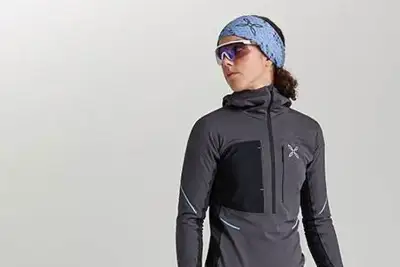
Initially developed for cycling brand Castelli, Polartec’s new AirCore fabrics are made from an electrospun membrane and are featured in Montura’s ski mountaineering range. 
Credit: Montura