








Milano Unica: ‘Luxury means raw materials’
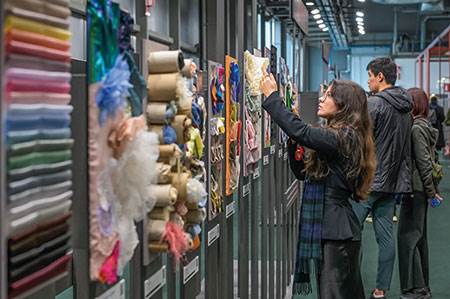
The sentiment at the Italian fair was that manufacturing needs to be put back in the spotlight to differentiate high-end textiles.
At Olympic level, fractions of a second make the difference between podium positions and missing out. Italy's Francesca Lollobrigida secured her second gold medal of the Milano Cortina Games by winning the women's 5,000m speed skating event in 6:46.17, edging out Merel Conijn of the Netherlands by a tenth of a second. This minute margin shows how important every single element – including the aerodynamic suit and fabric – is. And only two weeks earlier, some of those Winter Olympic fabric suppliers were among the 730 exhibitors at the 42nd edition of Milano Unica, held in the same venue at Fiera Milano Rho exhibition centre.
The show was described as a “litmus test” for industry sentiment, following a period of inflationary pressures, tariffs and geopolitical worries for the global fashion industry. Despite this, the number of European exhibitors increased by 25%, and organisers said the signs heading into 2026 were good. “Luxury means putting raw materials back in the spotlight, elevating them as the foundation of brand identity and credibility,” said show president Simone Canclini at the opening ceremony. “In a constantly changing luxury market, product, quality and expertise are once again key storytelling elements."
Among those suppliers invested in the Olympics was Germany-based Eschler, which was bought by Schoeller in 2012. However, it has been in its own race recently; one to reconfigure its suppliers after Schoeller announced last summer it was moving production to Asia, “a shock to the whole textiles industry”, according to a spokesperson. Eschler took over the knits side of the business, with other fabrics now produced out of Taiwan. Eschler works with national teams such as France, US, Italy, Germany, Slovenia, Switzerland and Japan for sports including speed skating, alpine skiing, racing and cycling, later crossing those innovations into the consumer sector for brands. For the teams they support, “at least one part of the garment is from Eschler, and often the whole suit,” he adds. “Once this Olympics is over, we will immediately begin producing for the next cycle, with new structured fabrics and innovations.”
There is a similar focus at Payen, with around 70% of competing nations having some element of Payen fabrics at the previous Games, according to a spokesperson. The French company specialises in high-stretch wovens and is among the last vertically integrated textiles companies in Europe, working from yarn spinning to dyeing, weaving and finishing. “Everything is specialised for a niche market – but it can be a big niche.” The company also makes lightweight, breathable compression fabrics, both for the sportswear and medical sectors, with new markets including compression-wear for people with dramatic weight loss. Novel materials on show included a wool-nylon blend, using wool’s thermoregulating properties to add warmth to next-to-skin stretch fabrics.
Wool gains ground
The increase in demand for wool was mentioned by several exhibitors, with the natural fibre seeing somewhat of a resurgence. Some highlighted merino’s rising price due falling supplies in Australia, coupled with higher demand from China, but British Wool and New Zealand suppliers have also noted growing demand and rising prices. Japanese company Miyuki Keori said sales of its 100% wool ‘denim’ had rocketed, and the UK Fashion and Textiles Association – which accompanied 27 mills to the show – placed emphasis on merino wool and tailoring fabrics, working in collaboration with The Campaign for Wool, The Woolmark Company and British Wool.
This trend has not yet been reflected in Italian textiles sales, which last year reached around €6.9 billion, a drop of around 1.5% from 2024, according to Confindustria Moda. Sales of wool – which makes up 40% of its textiles – silk and knits fell, but sales of cotton and linen textiles rose. The association warned the high levels uncertainty mean there are no concrete signs of recovery, but Mr Canclini noted there was better news in the third quarter of 2025, when growing sales volumes for cotton and linen fabrics made up for the losses accumulated in the previous two years.
Nature’s way
The Cotton Egypt Association, Supima Cotton and the Alliance for European Flax-Linen & Hemp were in attendance to support the natural fibres. The alliance was promoting the use of linen in sportswear, highlighting its breathability and thermoregulating properties. Fabrics by mill partners included linens with PU or water-repellent coatings, and blends with cotton, viscose and elastane. “There is a growing interest in natural fibres, and having the traceable story from Europe is also desirable,” they said.
Bulgaria-based down specialist Down Creators highlighted what it described as the first scrimless down wadding – with no textile layer to bind the feathers – suggesting it offers advantages in terms of end-of-life as well as processing. TX Down is made from 75% natural fibres and 25% ‘technical fibres’, which function as a glue. The company was launched 30 years ago to create a use for the by-product of the local duck meat industry, and it has since designed machinery and technology that has refined the sorting processes and made its systems more efficient.
Italian insulation specialist Thermore is a regular exhibitor at the Milano Unica, the combination of high-end and fashion buyers suiting its products. At the show, it introduced Thermore Freedom, which managing director Patrizio Siniscalchi described as a new generation of padding. “Thanks to a construction that adapts to every movement and the pioneering use of recycled fibres, including those from electronic components, Thermore Freedom guarantees stretch, shape recovery and lightweight warmth without compromise,” he says. “This product embodies our vision: active, high-performance warmth and a concrete approach to more responsible production methods."
MarediModa’s shared values
For the fourth time, European swimwear sector fair MarediModa held a ‘show in show’, supported by lead sponsor Lycra, with its exhibitors presenting collections in a dedicated area or in their own booths around the event. Claudio Taiana, president of MarediModa, told Sportstextiles the show was a good fit, with both events focusing on high-quality European textiles. Attending Milano Unica means exposure to buyers from Italian brands as well as a chance to fit into different buying calendars, with its main Cannes show taking place in the autumn. “The objective is to find companies not specifically focused on swimwear, as the stretch fabrics can be used for lots of end-uses,” he said. “You can discover brands doing something different, there is a lot of crossover.”
As part of the MarediModa delegation, circular knit specialist Eusebio presented a beachwear collection featuring smooth stretch nylon jerseys, and linings with coloured lurex, including new fabrics with Roica, which its Japanese maker Asahi Kasei describes as an “improved elastane”. The Iluna Group, which makes stretch laces, showed intricate geometric designs with luminous metallic accents. Its collection included Roica EF (made with pre-consumer recycled materials), GRS-certified lurex mesh fabrics and materials made with recycled polyamides such as Fulgar's Q-Nova and Radici's Renycle. Innova Fabrics’ Residual Free line featured blends of Sensil Biocare and Roica V550 – both designed to degrade.
Return to elegance
Italian mill Eurojersey, the maker of warp-knit stretch Sensitive fabrics, is expanding its presence in the women’s golf and tennis sectors, as well as into men’s sportswear, with an investment in new construction techniques combined with digital print technologies.
Marketing manager Michela delle Donne told Sportstextiles there is a return to elegance in the sportswear market, and its latest collection offers fabric combinations that speak to that trend. Its new 3-bar construction creates waffle piqué – a textured fabric with raised geometric or square designs – that can be digitally overprinted. “The surface is in relief, creating an elegant result,” she explained. As part of a vertical manufacturing set-up that includes weaving, dyeing and finishing north of Milan, Eurojersey has an in-house printing facility. General manager Andrea Crespi added: “When you touch a warp knit, it is usually flat, but we are combining the future of construction with the high-end printing technology, while maintaining the integrity of our Sensitive fabrics.”
Printed textiles were another theme mentioned by exhibitors, with a view that the technique can not only reduce the water and chemicals associated with dyeing but offers a flexible route to market or a way to refinish old stock – which could become more important with the incoming regulation that will require better solutions for unsold textiles.
Powdered leather on denim printed to look like jackets, and jeans designs printed on washable leather or other fabrics were on show at NextPrinting. Based in Bergamo and part of the ACM accessories group, it works with customers to create novel print effects. While digital printing is growing, it is important there is the know-how and not simply the machinery, project manager Philippe Mignot told us. “Our technicians know how to print on different fibres and fabrics, it can be complex to work out the shrinkage, for example.”
Shine on
JRC Reflex presented new textured materials that offer greater options for designers. The French-headquartered company adds minute glass beads to fabric at its facility in Italy, creating reflective materials in a variety of colours. The fabric is usually flat but by adding texture – in the form of raised squares, lines and hexagonal patterns – more character can be added. “This offers designers more choice,” chief executive Céline Cugerone told Sportstextiles.
Fifty-three textiles-makers travelled from Japan, supported by their government and the Japan Textile Association in the 10th year of the collaboration. With an “ultra-weak yen environment” at home, companies are looking to increase exports, organisers told us. Alongside performance fabrics manufacturers Toray and Sunwell was protein fibre developer Spiber. It is now testing a membrane that could be added to a down jacket, making it windproof and easier to recycle, said the company. It also presented an early-stage material that could be used as an alternative to leather.
At the close of the show, Milano Unica’s general manager Massimo Mosiello said the atmosphere confirmed “the moderate optimism about the positive prospects for 2026”, although concerns remain about the geopolitical context. The show closed with higher international buyer attendance, led by French (+8.5%) and US buyers (+13.5%), as well as increased attendance from Korea (+10%), Germany (+8%), Canada (+6.6%) and Japan (+2.4%). From the UK delegation, Abraham Moon’s Pam Birchenall and British Millerain’s Adam Getty both commented that the edition was the best in terms of numbers and quality of visitors since before covid.
Valentino Valentini, Deputy Minister of Enterprises, noted the Italian government is introducing regulations and funding to combat ultra-fast fashion, with €500 million allocated to support businesses become more innovative. “Milano Unica reminds us that without fabric and accessories, luxury and Made in Italy do not exist,” he said. “They are the essential ingredient, the substance that gives body to style, and in a complex two-year period like this, we must have the courage to put the industrial value of the product back at the centre, bringing attention back to real manufacturing.”
Milano Unica has partnered textiles recycler Wetex to turn all the fabric samples used by the fair into carpet to be used at the next edition.
Credit: Milano Unica



