Stick with it

12/05/2026
Stick with it

Science that won the Nobel Prize for chemistry as long ago as 1950 could have a role to play in the textile industry’s transition to the circular economy.

Two experienced chemists have claimed that a new technology platform they have developed can help boost the repair, reuse and recycling of outdoor garments and bring about a breakthrough for adhesives that can de-bond on demand.

D-Glue is the name of the platform that business partners Dr Kristoffer Stokes and Dr Phil Costanzo have launched. They view this as a potentially valuable component in the waterproof-breathable supply chain and elsewhere in the garment industry. Glue features prominently in clothes for the great outdoors. “Glues are everywhere in rain jackets,” Dr Stokes explains. “You spin the fibre, then you knit or weave your face fabric. But for waterproofing, if you opt for lamination, you have to glue the laminate in.” As well as membranes, adhesives are required for glued-on seam-tapes, too. Some manufacturers even glue in sew-free zippers, trims, toggles and overlays. 

Classroom and commerce

The two scientists have been friends since their student days, but D-Glue is the first business venture they have worked on together. Both have taught in universities (Dr Costanzo still does), and both have lent their expertise to research work for the US military. Dr Stokes then “went the business route” and has a background that includes a spell as product development director for sew-free technology provider Bemis Associates. He also worked at Celgard (now part of Asahi Kasei) and helped develop and commercialise an early polypropylene waterproof breathable material. Merrell brought that membrane to market in 2014. It was later used by Helly Hansen, too. More recently, he co-founded Boston-based Geisys Ventures, which specialises in helping companies make progress in research, technology and marketing. During his time at Bemis, he says questions about “defeatable adhesives” had begun to come from customers. Those early enquiries arrived “before the circular economy was a thing” and the potential benefit of having glues that, at some point, stop working was unclear to many. “That conversation has changed in the course of the last couple of years,” he says.

He explains that he always kept an eye on the “great work” his friend was doing in academia. Working with undergraduate students at California Polytechnic State University, Dr Costanzo had spent time on an idea he calls healable coatings. If coatings respond well to controlled exposure to heat, scratches and tears can be eminently repairable; one example he thought of was in coatings for cars. If you can remelt and reseal the coating, drivers will be able to mend scratches in the paintwork on their cars using an ordinary hairdryer. A conversation about this led to the idea of translating the same principle to adhesives. Work on the concept began at the start of the decade before the independent launch of D-Glue in mid-2025.

Mono-culture

In the circular economy, garment construction deserves our close attention. It means products have to last a long time and be repairable, and for the material we use to make them to be recyclable at end of life. Glue presents a challenge here. But so does stitching. For a nylon jacket to be easy to recycle it should be 100% nylon, which includes having nylon thread in the stitching. Nevertheless, mono-material garments are still the exception rather than the norm. A study from Belgium-based cleantech start-up Resortecs, which specialises in product disassembly, estimates that mono-material garments bought and sold in the European Union (EU) at the moment comprise 22% of the total market. This is a slow-changing picture: the study suggests that, at current rates of growth, it will take until 2035 for mono-material garments to reach a 30% share of the total. If a garment is not mono-material, recycling becomes more complicated.

Dr Stokes explains: “It’s hard to deconstruct clothing in an economic way without just cutting it apart. Our adhesive can help. If we use seam-tape to seal up the seams so that water doesn’t ingress, D-Glue can be a good replacement for the adhesives that are in use at the moment. When you put the garment in an oven for deconstruction, the seam-tape will fall off or be very easy to peel away. And if we glue whole panels together with our adhesive, you get the benefit of low-profile seams and fairly easy disassembly. The garment will disassemble itself in the oven and the panels will be in good condition for reuse.”

The business partners have set up D-Glue to be drop-in technology and, rather than as a single solution, to offer a platform for companies in the textile industry to use in the way that suits them best. “We know that there are many glues,” Dr Costanzo says, “and a singular product is not going to solve all our problems. We can formulate different glues to solve different problems.” This will involve different mechanisms for debonding as well. 

Other ideas

This magazine last wrote about reversible adhesives in 2024. Dr Barny Greenland at the University of Sussex in the UK has led research on the subject and had come to the conclusion that adding particles of iron or iron oxide to glue could make the adhesive responsive to targeted heat. This in turn would cause materials to de-bond, he has said. He thought this idea could work well in areas including footwear recycling, but Dr Greenland says now that he does not know of any footwear companies that have put his idea into practice.

Also in 2024, sports brand ASICS said it had used a reversible adhesive, developed in-house, in the construction of a shoe called the Nimbus Mirai. It said the new glue can provide durable bonding of materials while the shoe is in use, but that the bonding is reversible. ASICS said specifically that its aim was to make the upper of the Nimbus Mirai easily detachable from the sole during recycling processes. In this way, it explained, the whole of the upper can go through recycling and be turned into material the company can reuse to make new shoes. As of the first quarter of 2026, as far as we can tell, the Nimbus Mirai is no longer available for sale from ASICS and the Japan-based company has made no further reference to the reversible adhesive it developed.

Core question

Without knowing these examples from the inside, Phil Costanzo is reluctant to speculate on what the reasons might be for a lack of progress with previous efforts to make reversible adhesive scalable and a commercial success. But he says finding ways to apply heat to a construction addresses only part of the problem. How polymers assemble and come apart is the core question, he suggests. It takes a lot of energy to break a covalent bond, he explains, and even if you succeed, the bond breaks apart randomly.

To address this, D-Glue uses chemistry that has been around for more than 75 years. It is based on an idea that won the Nobel Prize in chemistry in 1950. That year, the Royal Swedish Academy of Sciences awarded the prize to German chemists Otto Diels and Kurt Alder. This is chemistry that is now “really well understood”, Dr Costanzo explains. D-Glue’s effectiveness comes from the addition of two extra molecules to conventional adhesive formulations. Both of these secret extra ingredients are widely available and purchasable at scale. They provide a thermal trigger, which means the response of these ingredients to heat is what will rearrange the chemical bonds at a molecular level, make the adhesive de-bond and, the chemist says, cause a garment to fall apart.

Simple chemistry

Formulations using D-Glue can be designed to break apart at different temperatures and using different amounts of energy. The developers say it is tuneable, depending on a substrate’s needs. It can be formulated to de-bond with high heat for a short time, low heat for a long time, or at mixed temperatures, all of which helps to maintain the integrity of materials, making them easier to use again. It even allows for what they call “patterned de-bonding”, for when there is different adhesive in different parts of a garment. At the moment of application, the D-Glue technology works as a liquid adhesive. It can also work in a glue stick format, which makes it easy to store and to transport to different workstations in a factory. 

“We are not synthesising things from ground-zero,” Phil Costanzo continues. “We are taking existing products and adding properties and capabilities to them through simple chemistry. We can take this thermal process and put it into a variety of components: a urethane, an epoxy, a siloxane and others. We can engineer in our network and in precise locations specific types of bond with what chemists refer to as Diels-Alder linkages [named after the Nobel Prize laureates]. We can control how a bond falls apart and the timeframe and the temperature for that.”

Drop in the bucket

Working with undergraduates rather than graduate students means he knows his teaching time with them will be short. The students will soon move on to other things. Because time is short, the tasks Dr Costanzo’s students carry out have to be affordable and easy to replicate. The programme has to have what he calls “a robust methodology”. This is sometimes called ‘bucket chemistry’, he continues, “because, literally, you could do this by putting everything in a bucket”, adding ingredients one by one and stirring. Undergraduates are also “really good at breaking things”, he says fondly. The benefit of this is that it flags up any weak points in your synthesis, which could harm your ability to make a lot of what you want to make, and to do so cheaply.

He points out that academics often try to make an impact in the business world after “cute experiments” have worked in the lab, but then find their ideas cannot scale. The D-Glue partners are under no illusions about this. Kristoffer Stokes says the barrier between success in the laboratory and success in the market is so difficult to overcome it is known in the conversation between academia and business as ‘The Valley of Death’. He insists that a focus on what is readily available will make scalability more achievable. Scalability also means “an avenue to hit many markets”.

Early stages

Under new rules in the EU, producers that make textiles available in any of the 27 member states will be obliged to cover the cost of their collection, sorting and recycling at end of life, through new producer responsibility (EPR) schemes. Kristoffer Stokes believes this will help make the case for solutions like defeatable or debondable glues.

Industry partners have already succeeded in replicating D-Glue procedures at an industrial level. Because D-Glue works as a technology platform, Kristoffer Stokes says partners can “sprinkle it into their existing formulations” and make them de-bondable. Some of the partners involved in this early work are already aiming to bring the results to the textile industry. They have seen it work at “loadings that make it economically feasible”, he adds. These are the early stages, but he believes this will be a way for these partners to transfer their customers to a new formulation that adds value for everyone in the supply chain. He identifies seam-tapes, low-profile intimates and replacements for elastics as good potential early applications.

“We are not aiming for the mass-market,” he concludes. “We would not be able to satisfy the demand at the moment. We have an idea that the pricing should be competitive, close to price-parity with other technologies.” This means that for smaller, sustainability-focused capsule collections, brands can make D-Glue part of their circular story, adding value “without a major price premium”.

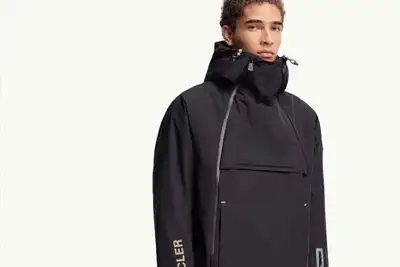
Glues are everywhere in rain jackets, according to Dr Kristoffer Stokes. Credit: Moncler