






From the ground up
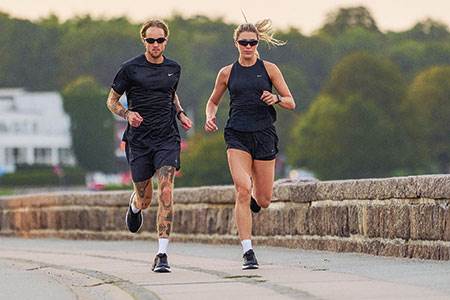
Twenty-five years of learning about the footwear industry from the inside have allowed Nikolai Christensen the freedom to do things differently with start-up brand Movv.
A start-up footwear brand from Denmark has said the running shoes it has developed can help prevent foot injuries, now and in the future. The brand, Movv, launched its first shoe, the Nostara, earlier this year. Founder, Nikolai Christensen, began work on it in 2024 following 25 years in the shoe industry. The launch of a second model, the Solara, followed this September.
Mr Christensen describes the Nostara as a neutral running shoe, while the Solara is aimed specifically at runners who have a tendency to over-pronate. He says these shoes are the fruits of his analysis of the scans of a million feet.
He has worked closely with Kaiser Sport & Ortopædi (KSO), a Danish company that runs stores and clinics around the country. As well as offering footwear and clothing for runners, it carries out assessments of people’s running styles and recommends treatment for injuries. A 3D foot-scan is always part of a KSO assessment. In a similar way, Runners’ Lab has been working to provide these services to runners in Belgium since 1980.
Studying anonymised data from these partners helped Nikolai Christensen build on the understanding of the biomechanics of the foot, and knowledge of lasts and shoes that he built up in a quarter of a century working for major footwear brands, including Ecco and Keen. Information from the scans has allowed Movv to build up a picture of what he calls “real-world running patterns”. The start-up accepts that, in keeping with the Pareto principle, there will always be around 20% of people whose feet do not fit ‘the norm’, but this exercise has helped Mr Christensen design and make running shoes that will fit a majority of European consumers well, while supporting natural movement and helping keep bones, ligaments, tendons and muscles healthy.
“We were able to start Movv with a strong foundation,” he explains. “Before colours, price-points and even product quality, everything for us started with biomechanics. Understanding of the foot turns into a last. The last turns into the inner core of the shoe, and we have built everything around that.”
In the design loop
To be able to keep adding to his stock of information, he embeds a near-field communication (NFC) chip into each shoe to make it easy and quick for runners who choose Movv to give feedback on how the shoes feel after each run. If these customers believe improvement is necessary in the heel counter or in the cushioning or even in the quality of the laces, he wants to know. And if he believes this interaction can help him improve the product, he can convey changes to his manufacturing partners right away. NFC chips do not track a runner’s movement, but a tap on the chip with the user’s phone can deliver detailed content from the brand and give opportunities for feedback to enhance its products. Mr Christensen calls this ‘co-creation’, which stems from being “the runners’ friend”, being able to look them in the eye and talk to them on their own terms. This is something that he says matters a lot to him. He calls it “a living design-loop between us and the runner”.
“I wanted to build this in from the beginning,” he says. “I have respect for lots of footwear brands and it’s not for me to tell them what to do. It’s enough for me to stick to my business. But one advantage you have as a small start-up is that you can have this level of agility and, so far, enough people are willing to interact to make this work. Some people are too busy, of course, and I respect that. The ones who are interested in this are very committed and really want to see change.”
Other priorities
It is possible that the bigger a company grows, the harder it will be for it to interact with consumers in this way. Perhaps scale simply will not allow it. Legacy systems often prioritise other things: production volumes, seasonal turnover, marketing cycles and so on.
Sometimes, runners who interact with Movv have been surprised to receive suggestions from the founder that they should try other brands as well, but he has done this from the outset. Because the Nostara is a neutral shoe, he told runners who needed a shoe with more support to try something else. This, of course, was before bringing his own support shoe, the Solara. In any case, it was an opportunity to show that Movv is, in his words, “an authentic brand, one that cares about the fit, comfort and health of customers”.
His belief is that combining different shoes in a rotation can be of benefit to runners’ health. “They will flex their feet in different ways and their bodies will grow stronger,” he says. “You don’t need to wear the same shoes to train in as you will wear when you race.”
Good for muscles, bad for bones
He argues that the soft shoes that have come to dominate the running footwear market are good for building up muscles. Because the materials are soft, the muscles have to work hard to establish and keep stability. But he is sure these shoes are less good at building ligament and bone strength, benefits he has incorporated into the lower-stacked Nostara and the Solara. He explains: “If the shoe is too soft, the receptors at the nerve endings will not send the same signals to the bones, and the bones will not work as hard. Muscles, tendons, ligaments and bones all work in the same way: if they are not put under any pressure they will not grow stronger. Ten years from now, a lot of runners who have only ever run in soft shoes could have some bone atrophy problems.”
Some higher-stacked running shoes now have so much super-critical foam in them they make the Movv founder think of “a pair of stilts”, making the response that the shoes demand of the wearer’s body incomplete. This is because the anatomical connection with the ground changes fundamentally. The higher the stack and the softer the shoe, the more problematic this will be, he insists, suggesting that while the appeal of lightness, softness and comfort is understandable, “the pendulum always swings too far”.
Evolution curve
Movv shoes are not minimalist. Mr Christensen understands the popularity of minimalist shoes, but he believes running shoes need to reflect some of the ways in which the human foot has evolved. His shoes have an asymmetrical heel landing because, he explains, people land underneath their bodies and this makes their feet asymmetrical on impact. The shoes also have a proprietary forefoot design. The last that Movv uses is flat under the forefoot rather than curved. Its design is one that allows the toes to spread into “a natural position” to gain power for pushing off. Running shoes often squeeze the forefoot in a downward curve, he observes, but the foot is flat there, so his shoes are, too. Other features include a “dynamic arch comfort system” that adapts to the wearer’s foot to improve stability in the gait, while gently stimulating the arch to build strength and flexibility.
Twenty-five years of learning about the footwear industry, from the inside, have allowed him the freedom to build Movv from scratch, but “without re-inventing all the wheels”. His intention is to invest everything he can in the product rather than in offices or large teams of employees. The community he is building is with runners who are interacting with the brand and co-creating with it. He is committed to using those connections to keep learning and improving, and for data from real runners to continue to drive design.
“The freedom to build from scratch is powerful,” Mr Christensen continues, “but it also means you are building every system, every relationship and every process from zero. In a time of global supply chain disruption, that’s a real challenge. Lead times are unpredictable, material costs fluctuate and logistics can be volatile. But because we are small and agile, we can adapt quickly. We have chosen partners who share our values and are willing to grow with us. And because we do not chase seasonal drops, we are not under pressure to overproduce or discount. That gives us more control and stability, even in uncertain times.”
Lasting support
The Solara’s development exemplifies this. Movv has taken its time to develop this second shoe and bring it to market, even though it realised early on that enough runners are prone to over-pronation to make it worthwhile to offer to help them. Working out how best to provide this help required thought, time and work. “The material in the shoe has to be harder,” the founder explains, “to ease the stress on ligaments, tendons and bones. Firmer, harder material will hold the foot when it moves.” He adds that bigger brands’ use of neutral shoes with added guide-rails in the upper does not offer lasting support. He has created hold in the upper, but also in the sole by using contrasting densities; both components share the workload. The Nostara weighs around 350 grammes, but will “take a beating for 1,000 kilometres” according to its inventor, who is not a fan of “the fast-fashion mindset that dominates much of the footwear industry” and has made simplicity and durability Movv’s core values. He thinks it will be worth carrying an extra 50 grammes per shoe in the Solara for runners who over-pronate to put energy into moving forward rather than moving inwards and, in addition, save themselves from developing tendon problems in the knee or in the ankle.
He is convinced that either the neutral Nostara or the supportive Solara would work for most people in the market, that one or other of these models would suit 95% of the runners in the world. But he makes it clear there is more to come, saying: “We have a great foundation, and we have runners that want to go faster, for example. This is what we will concentrate on next time.” He adds that the Solara is a natural step forward from the Nostara and that there are many more steps to come. It is already working on new models that address different movement needs, products that will help keep people moving, pain-free.
Movv insists its shoes can help prevent injury to the ligaments, tendons and bones. The Solara style incorporates support into the sole and the upper.
ALL CREDITS: Movv



