Cotton Diaries appeals for more realistic mapping that values the gin
In a new report, Cotton Diaries, an independent research organisation, seeks to alert policymakers on the intricacies of cotton traceability and what type of data will best serve the farmers and industry at large. “Is cotton traceability too complex – or are we just mapping it wrong?” was written by Anne Oudard, with input and guidance from Marzia Lanfranchi and Simon Ferrigno.
The report argues that current cotton tracing methods fail to account for the gin stage, the point when cotton transitions from agriculture to industry. “In practice, cotton delivered to gins is documented by volume, origin and supplier (farmers or farmer groups) to organise payments and trade. Yet this information rarely travels further down the supply chain,” the report states.
Cotton Diaries is calling on EU policymakers to recognise ginning as a distinct stage in cotton supply chain mapping; require transaction-based record-keeping; and keep certification as a supplementary layer.
Cotton is lodged in the apparel supply chain’s Tier 4, categorised as ‘raw material extraction’. The next step is Tier 3, which covers ‘raw material transformation’, and tends to refer to spinning operations. The report notes that gins occasionally describe themselves jokingly as Tier 3.5. “We believe ginning should remain within Tier 4. In most frameworks, Tier 3 refers to spinning mills, which are often located far from the regions where cotton is grown and ginned. Grouping these two stages within the same tier would combine actors that are geographically distant. A more coherent approach may be to divide Tier 4 into two sub-levels: Tier 4.1 – Ginners and Tier 4.2 – Farmers,” the report suggests. It further argues that for other natural materials, such as wood or fish, every lot has a traceable origin and a known supplier.
“Gins are the textile industry’s door into agriculture. Once we map them clearly, the path upstream opens, making it possible to understand where cotton truly comes from and how it affects people and the environment,” commented Anne Oudard, Sourcing and Supply Chain Lead for Cotton Diaries.
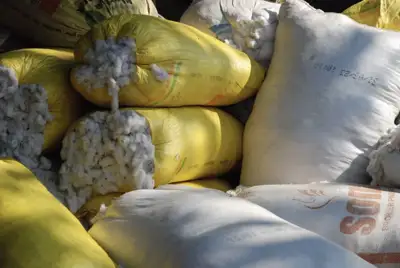
Bags of cotton before ginning